- Algebra
- Answer
Given that and are nonzero real numbers such that and , find all possible values of .
Harvard-MIT Mathematics Tournament 2014.
Given that and are nonzero real numbers such that and , find all possible values of .
Find the integer closest to
Let
Compute .
Let and be real numbers, and define the polynomial . Suppose that , and that . Find .
Find the sum of all real numbers such that .
Given that and are complex numbers such that and , find the smallest possible value of . Here, denotes the absolute value of a complex number, given by whenever and are real numbers.
Find the largest real number such that
whenever are real numbers such that and is the median of .
Find all real numbers such that is true for exactly one real number .
Given that , and are complex numbers satisfying
compute . (Here, .)
For an integer , let denote the number of positive integers dividing . Suppose that is a positive integer and are real numbers such that for all . Find the smallest possible value of .
Let and be concentric circles with radii 4 and 6 , respectively. A chord is drawn in with length 2. Extend to intersect in points and . Find .
Point and line are such that the distance from to is 12 . Given that is a point on such that , find the radius of the circle passing through and tangent to at .
is a triangle such that . Let be the midpoint of side . Given that is parallel to the external bisector of , find area of triangle . (Lines and form two angles, one of which is . The external bisector of is the line that bisects the other angle.)
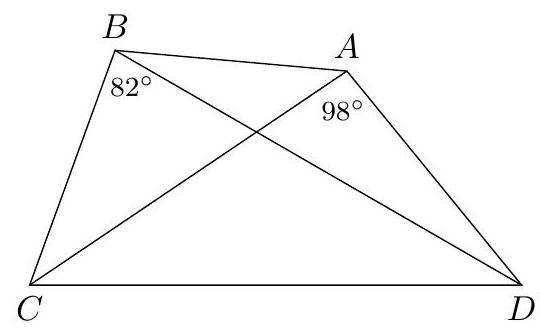
In quadrilateral , and . Find .
Let be a circle in the plane with radius 1 and center , and let be a point in space with coordinates . Find the largest possible radius of a sphere that is contained entirely in the slanted cone with base and vertex .
In quadrilateral , we have , and . Let and meet at . Compute .
Triangle has sides , and . It is inscribed in circle , which has center . Let be the midpoint of , let be the point on diametrically opposite , and let be the intersection of and . Find the length of .
Let be a triangle with sides , and . Let and be the midpoints of and , respectively. Choose the point on ray so that the circumcircle of triangle is tangent to . Find the area of triangle .
Two circles are said to be orthogonal if they intersect in two points, and their tangents at either point of intersection are perpendicular. Two circles and with radii 10 and 13 , respectively, are externally tangent at point . Another circle with radius passes through and is orthogonal to both and . A fourth circle , orthogonal to , is externally tangent to and . Compute the radius of .
Let be a triangle with , and . Let be the circumcircle of , let be its circumcenter, and let be the midpoint of minor arc . Circle is internally tangent to at , and circle , centered at , is externally tangent to at a point . Ray meets segment at point , such that . Find the radius of .
There are 100 students who want to sign up for the class Introduction to Acting. There are three class sections for Introduction to Acting, each of which will fit exactly 20 students. The 100 students, including Alex and Zhu, are put in a lottery, and 60 of them are randomly selected to fill up the classes. What is the probability that Alex and Zhu end up getting into the same section for the class?
There are 10 people who want to choose a committee of 5 people among them. They do this by first electing a set of , or 4 committee leaders, who then choose among the remaining people to complete the 5 -person committee. In how many ways can the committee be formed, assuming that people are distinguishable? (Two committees that have the same members but different sets of leaders are considered to be distinct.)
Bob writes a random string of 5 letters, where each letter is either , or . The letter in each position is independently chosen, and each of the letters is chosen with equal probability. Given that there are at least two 's in the string, find the probability that there are at least three 's in the string.
Find the number of triples of sets such that: (a) . (b) . (c) .
Here, denotes the number of elements in the set .
Eli, Joy, Paul, and Sam want to form a company; the company will have 16 shares to split among the 4 people. The following constraints are imposed:
Assuming that shares are indistinguishable, but people are distinguishable, in how many ways can the shares be given out?
We have a calculator with two buttons that displays an integer . Pressing the first button replaces by , and pressing the second button replaces by . Initially, the calculator displays 0 . How many integers less than or equal to 2014 can be achieved through a sequence of arbitrary button presses? (It is permitted for the number displayed to exceed 2014 during the sequence. Here, denotes the greatest integer less than or equal to the real number .)
Six distinguishable players are participating in a tennis tournament. Each player plays one match of tennis against every other player. There are no ties in this tournament- each tennis match results in a win for one player and a loss for the other. Suppose that whenever and are players in the tournament such that wins strictly more matches than over the course of the tournament, it is also true that wins the match against in the tournament. In how many ways could the tournament have gone?
The integers are written in the squares of a chess board, such that for each , the numbers and are in squares that share an edge. What is the largest possible sum that can appear along one of the diagonals?
There is a heads up coin on every integer of the number line. Lucky is initially standing on the zero point of the number line facing in the positive direction. Lucky performs the following procedure: he looks at the coin (or lack thereof) underneath him, and then,
He repeats this procedure until there are 20 coins anywhere that are tails up. How many times has Lucky performed the procedure when the process stops?
An up-right path from to is a finite sequence of points in such that , and for each we have that either or . Two up-right paths are said to intersect if they share any point.
Find the number of pairs where is an up-right path from to is an up-right path from to , and and do not intersect.
Let be a circle, and let and be two points in its interior. Prove that there exists a circle passing through and that is contained in the interior of .
Let be an infinite sequence of integers such that divides for all , and let be the remainder when is divided by 210 . What is the maximal number of distinct terms in the sequence ?
There are girls and boys . A pair is called suitable if and only if girl is willing to marry boy . Given that there is exactly one way to pair each girl with a distinct boy that she is willing to marry, what is the maximal possible number of suitable pairs?
Compute
(Here, if is a real number, then denotes the largest integer less than or equal to .)
Prove that there exists a nonzero complex number and a real number such that
for all with and . (Here, denotes the absolute value of the complex number , so that for real numbers .)
Let be a positive integer. A sequence of integers is acceptable if it satisfies the following conditions: (a) . (b) The sets and are equal.
Prove that the number of acceptable sequences of integers is !.
Find the maximum possible number of diagonals of equal length in a convex hexagon.
Let be an acute triangle with circumcenter such that , and . Let be the foot of the altitude from to , and be the intersection of with . Suppose that is on between and such that there is a point on satisfying and . Determine the length of .
For integers , let be the number of sequences of integers satisfying the following two properties: (a) Each integer with occurs exactly times in the sequence . (b) If , and are integers such that and , then occurs in the sequence at least as many times as does.
For example, if and , a possible sequence is . On the other hand, the sequence does not satisfy property (2) for , and . Prove that .
Fix a positive real number and positive integer . Initially, a blackboard contains the numbers . Every minute, Bob chooses two numbers on the board and replaces them with . Prove that after minutes, the blackboard contains a single number no less than
where and .
Let be defined so that for each is a (uniformly) random integer between 1 and 6 inclusive. Find the expected number of integers in the set that are multiples of 6 .
Let be a regular hexagon. Let be the circle inscribed in . Find the ratio of the area of circle to the area of rectangle .
Let be the set of divisors of 100 . Let be the set of integers between 1 and 100, inclusive. Mark chooses an element of and an element of uniformly at random. What is the probability that divides ?
If four fair six-sided dice are rolled, what is the probability that the lowest number appearing on any die is exactly 3 ?
Find all integers for which is an integer.
The Evil League of Evil is plotting to poison the city's water supply. They plan to set out from their headquarters at and put poison in two pipes, one along the line and one along the line . However, they need to get the job done quickly before Captain Hammer catches them. What's the shortest distance they can travel to visit both pipes and then return to their headquarters?
The numbers are written on a blackboard. You repeatedly take two numbers on the blackboard, subtract one from the other, erase them both, and write the result of the subtraction on the blackboard. What is the largest possible number that can remain on the blackboard when there is only one number left?
Compute the side length of the largest cube contained in the region
of three-dimensional space.
Find the number of nonempty sets of subsets of the set such that: (a) For any subsets . (b) If , and , then .
Two fair octahedral dice, each with the numbers 1 through 8 on their faces, are rolled. Let be the remainder when the product of the numbers showing on the two dice is divided by 8 . Find the expected value of .
Find a nonzero monic polynomial with integer coefficients and minimal degree such that . (A polynomial is called monic if its leading coefficient is 1.)
An auditorium has two rows of seats, with 50 seats in each row. 100 indistinguishable people sit in the seats one at a time, subject to the condition that each person, except for the first person to sit in each row, must sit to the left or right of an occupied seat, and no two people can sit in the same seat. In how many ways can this process occur?
Let be a trapezoid with and . Suppose that there is a point on such that and that triangles and are similar, but not congruent. Given that , find .
Given a regular pentagon of area 1, a pivot line is a line not passing through any of the pentagon's vertices such that there are 3 vertices of the pentagon on one side of the line and 2 on the other. A pivot point is a point inside the pentagon with only finitely many non-pivot lines passing through it. Find the area of the region of pivot points.
Suppose that and are positive real numbers such that . Find the maximum possible value of .
Let be a function satisfying the following conditions: (a) . (b) whenever and are positive integers with . (c) for all positive integers .
How many possible values can the 2014-tuple take?
Find the number of ordered quadruples of positive integers such that , and are all (not necessarily distinct) factors of 30 and .
Let be a trapezoid with . The bisectors of and meet at , the bisectors of and meet at , the bisectors of and meet at , and the bisectors of and meet at . Quadrilaterals and have areas 24 and 36, respectively, and triangle has area 25 . Find the area of triangle .
A deck of 8056 cards has 2014 ranks numbered 1-2014. Each rank has four suits-hearts, diamonds, clubs, and spades. Each card has a rank and a suit, and no two cards have the same rank and the same suit. How many subsets of the set of cards in this deck have cards from an odd number of distinct ranks?
Compute the number of ordered quintuples of nonnegative integers ( ) such that and 5 divides .
Let be a circle, and let be a quadrilateral inscribed in . Suppose that and intersect at a point . The tangent to at meets line at a point , so that lies between and . Given that , and , find .
Let . Choose a 50 -element subset of at random. Find the expected number of elements of the set .
Let be a set of distinct positive integers such that the mean of the elements of any nonempty subset of is an integer. Find the smallest possible value of the sum of the elements in .
Let be an equilateral triangle of side length 6 inscribed in a circle . Let be the points (distinct from ) where the lines through passing through the two trisection points of meet . Define similarly. Given that appear on in that order, find the area of hexagon .
For , define
where the product is over all except . Evaluate
Suppose that and are two sequences of integers such that the sequence contains each of the numbers exactly once. What is the maximum possible value of the sum
Let and be polynomials of degree 2014 such that for . Find the coefficient of in .
Natalie has a copy of the unit interval that is colored white. She also has a black marker, and she colors the interval in the following manner: at each step, she selects a value uniformly at random, and (a) If she colors the interval with her marker. (b) If she colors the intervals and with her marker.
What is the expected value of the number of steps Natalie will need to color the entire interval black?
Let be a triangle with circumcenter , incenter , and . Find .
Find all ordered pairs of complex numbers with , and .
An up-right path from to is a finite sequence of points in such that , and for each we have that either or . Let be the set of all up-right paths from to . What fraction of the paths in do not contain any point such that ? Express your answer as a decimal number between 0 and 1. If is the actual answer to this question and is your answer, then your score on this problem is .
Consider a number line, with a lily pad placed at each integer point. A frog is standing at the lily pad at the point 0 on the number line, and wants to reach the lily pad at the point 2014 on the number line. If the frog stands at the point on the number line, it can jump directly to either point or point on the number line. Each of the lily pads at the points on the number line has, independently and with probability , a snake. Let be the probability that the frog can make some sequence of jumps to reach the lily pad at the point 2014 on the number line, without ever landing on a lily pad containing a snake. What is ? Express your answer as a decimal number. If is the actual answer to this question and is your answer, then your score on this problem is .
How many times does the letter "e" occur in all problem statements in this year's HMMT February competition? If is the actual answer to this question and is your answer, then your score on this problem is .
We have two concentric circles and with radii 1 and 2 , respectively. A random chord of is chosen. What is the probability that it intersects ? Your answer to this problem must be expressed in the form , where and are positive integers. If your answer is in this form, your score for this problem will be , where is the total number of teams who submit the answer (including your own team), and is the total number of teams who submit a valid answer. Otherwise, your score is 0 . (Your answer is not graded based on correctness, whether your fraction is in lowest terms, whether it is at most 1, etc.)