- Algebra
- Answer
Let and be real numbers with such that and . Find the value of .
Harvard-MIT Mathematics Tournament 2013.
Let and be real numbers with such that and . Find the value of .
Let be an arithmetic sequence and be a geometric sequence such that the first four terms of are , and 0 , in that order. What is the 10 th term of ?
Let be the set of integers of the form , where are pairwise distinct non-negative integers. Determine the 100 th smallest element of .
Determine all real values of for which there exist distinct complex numbers such that the following three equations hold:
Let and be real numbers, and let , and be the roots of . Also, has roots , and . If , find the maximum possible value of .
Find the number of integers such that
Compute
Let be complex numbers such that and . Find all possible values of .
Let be a non-real complex number with . Compute
Let be a positive integer whose decimal representation contains 11235 as a contiguous substring, and let be a positive integer such that . Find the minimum possible value of
Jarris the triangle is playing in the plane. Let his maximum coordinate be . Given that he has side lengths 6,8 , and 10 and that no part of him is below the -axis, find the minimum possible value of .
Let be an isosceles trapezoid such that , and . Let be a point in the plane such that and . Compute .
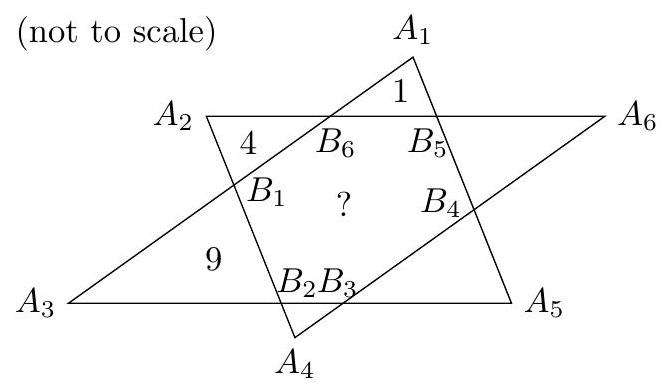
Let be a convex hexagon such that for (we take for each . Segment intersects segment at , for , as shown. Furthermore, suppose that . Given that 4, and (by we mean the area of ), determine the area of hexagon .
Let and be circles with centers and , respectively, and radii and , respectively. Suppose that is on . Let be one of the intersections of and , and be one of the two intersections of line with . If , find all possible values of .
In triangle and is the midpoint of . intersects the circumcircle of for the second time at , and . Find , where is the circumcenter of .
Let be a quadrilateral such that , and . Let and be on such that and are perpendicular to . Suppose that . Determine the product of the smallest and largest possible lengths of .
Let be an obtuse triangle with circumcenter such that and . Suppose that meets at , and that . Find .
Let be a convex quadrilateral. Extend line past to meet line at and extend line past to meet line at . Suppose that line bisects . If , and , compute .
Pentagon is given with the following conditions: (a) (b) , and (c)
Compute .
Triangle is inscribed in a circle . Let the bisector of angle meet at and at . Let the reflections of across and be and , respectively. Suppose that , and . If the tangent to at meets line at , and the circumcircle of meets line at (other than ), compute .
A standard 52 -card deck contains cards of 4 suits and 13 numbers, with exactly one card for each pairing of suit and number. If Maya draws two cards with replacement from this deck, what is the probability that the two cards have the same suit or have the same number, but not both?
If Alex does not sing on Saturday, then she has a chance of singing on Sunday; however, to rest her voice, she never sings on both days. If Alex has a chance of singing on Sunday, find the probability that she sings on Saturday.
On a game show, Merble will be presented with a series of 2013 marbles, each of which is either red or blue on the outside. Each time he sees a marble, he can either keep it or pass, but cannot return to a previous marble; he receives 3 points for keeping a red marble, loses 2 points for keeping a blue marble, and gains 0 points for passing. All distributions of colors are equally likely and Merble can only see the color of his current marble. If his goal is to end with exactly one point and he plays optimally, what is the probability that he fails?
How many orderings of exist such that ?
At a certain chocolate company, each bar is 1 unit long. To make the bars more interesting, the company has decided to combine dark and white chocolate pieces. The process starts with two bars, one completely dark and one completely white. At each step of the process, a new number is chosen uniformly at random between 0 and 1 . Each of the two bars is cut units from the left, and the pieces on the left are switched: each is grafted onto the opposite bar where the other piece of length was previously attached. For example, the bars might look like this after the first step:
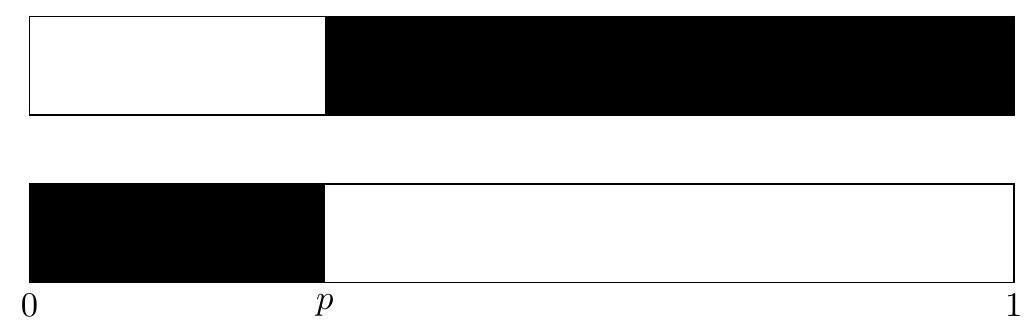
Each step after the first operates on the bars resulting from the previous step. After a total of 100 steps, what is the probability that on each bar, the chocolate units from the left is the same type of chocolate as that units from the left?
Values are chosen independently and at random from the set . What is expected number of distinct values in the set ?
A single-elimination ping-pong tournament has players, seeded in order of ability. If the player with seed plays the player with seed , then it is possible for to win if and only if . For how many players it is possible for to win? (In each round of a single elimination tournament, the remaining players are randomly paired up; each player plays against the other player in his pair, with the winner from each pair progressing to the next round and the loser eliminated. This is repeated until there is only one player remaining.)
It is known that exactly one of the three (distinguishable) musketeers stole the truffles. Each musketeer makes one statement, in which he either claims that one of the three is guilty, or claims that one of the three is innocent. It is possible for two or more of the musketeers to make the same statement. After hearing their claims, and knowing that exactly one musketeer lied, the inspector is able to deduce who stole the truffles. How many ordered triplets of statements could have been made?
Given a permutation of , let to be the number of fixed points of - that is, the number of such that . If is the set of all possible permutations , compute
(Here, a permutation is a bijective mapping from to .)
Rosencrantz and Guildenstern each start with and are flipping a fair coin. When the coin comes up heads Rosencrantz pays Guildenstern and when the coin comes up tails Guildenstern pays Rosencrantz . Let be the number of dollars Rosencrantz is ahead of his starting amount after flips. Compute the expected value of .
Let and be real numbers such that . Find all possible values of .
A cafe has 3 tables and 5 individual counter seats. People enter in groups of size between 1 and 4 , inclusive, and groups never share a table. A group of more than 1 will always try to sit at a table, but will sit in counter seats if no tables are available. Conversely, a group of 1 will always try to sit at the counter first. One morning, groups consisting of a total of people enter and sit down. Then, a single person walks in, and realizes that all the tables and counter seats are occupied by some person or group. What is the minimum possible value of ?
Let be a triangle with circumcenter such that . Suppose that the circumcircle of is tangent to at and intersects the line at and . Let intersect at . Compute BE.
Let be real numbers whose sum is 20 . Determine with proof the smallest possible value of
Thaddeus is given a array of integers each between 1 and 2013 , inclusive. He is allowed two operations:
He would like to get an array where all integers are divisible by 2013. On how many arrays is this possible?
Let triangle satisfy and have incenter and circumcircle . Let be the intersection of and (with distinct). Prove that is the midpoint of .
There are children and toys such that each child has a strict preference ordering on the toys. We want to distribute the toys: say a distribution dominates a distribution if in , each child receives at least as preferable of an toy as in . Prove that if some distribution is not dominated by any other, then at least one child gets his/her favorite toy in that distribution.
Let points and be on circle centered at . Suppose that and are circles not containing which are internally tangent to at and , respectively. Let and intersect at and such that is inside triangle . Suppose that line meets again at and let line intersect at . If , prove that , and are collinear.
Let be an odd positive integer greater than 1 . Let be the set of all non-negative integers less than which are of the form , where is divisible by . Let be the number of elements of . (a) Prove that if are relatively prime odd integers greater than 1 . (b) Find a closed form for , where is an integer and is an odd prime.
Chim Tu has a large rectangular table. On it, there are finitely many pieces of paper with nonoverlapping interiors, each one in the shape of a convex polygon. At each step, Chim Tu is allowed to slide one piece of paper in a straight line such that its interior does not touch any other piece of paper during the slide. Can Chim Tu always slide all the pieces of paper off the table in finitely many steps?
Arpon chooses a positive real number . For each positive integer , he places a marker at the point in the plane. Suppose that two markers whose coordinates differ by 4 have distance 31. What is the distance between the markers at and ?
The real numbers satisfy . If their squares form an arithmetic progression with common difference 2 , determine the minimum possible value of .
Find the rightmost non-zero digit of the expansion of (20)(13!).
Spencer is making burritos, each of which consists of one wrap and one filling. He has enough filling for up to four beef burritos and three chicken burritos. However, he only has five wraps for the burritos; in how many orders can he make exactly five burritos?
Rahul has ten cards face-down, which consist of five distinct pairs of matching cards. During each move of his game, Rahul chooses one card to turn face-up, looks at it, and then chooses another to turn face-up and looks at it. If the two face-up cards match, the game ends. If not, Rahul flips both cards face-down and keeps repeating this process. Initially, Rahul doesn't know which cards are which. Assuming that he has perfect memory, find the smallest number of moves after which he can guarantee that the game has ended.
Let be the region in the Cartesian plane of points satisfying , and . Determine the area of .
Find the number of positive divisors of such that .
In a game, there are three indistinguishable boxes; one box contains two red balls, one contains two blue balls, and the last contains one ball of each color. To play, Raj first predicts whether he will draw two balls of the same color or two of different colors. Then, he picks a box, draws a ball at random, looks at the color, and replaces the ball in the same box. Finally, he repeats this; however, the boxes are not shuffled between draws, so he can determine whether he wants to draw again from the same box. Raj wins if he predicts correctly; if he plays optimally, what is the probability that he will win?
I have 8 unit cubes of different colors, which I want to glue together into a cube. How many distinct cubes can I make? Rotations of the same cube are not considered distinct, but reflections are.
Wesyu is a farmer, and she's building a cao (a relative of the cow) pasture. She starts with a triangle where angle is , angle is , and is 1 . She then extends the pasture. First, she extends to such that and the new pasture is triangle . Next, she extends to such that . She continues, each time extending to such that . What is the smallest such that her pasture never exceeds an area of ?
Compute the prime factorization of 1007021035035021007001 . (You should write your answer in the form , where are distinct prime numbers and are positive integers.)
For how many integers does the decimal representation of end with a 1 ?
Find the smallest positive integer such that .
Consider triangle with . The angle bisectors from and intersect at , and the angle bisector from intersects at . If , compute .
Tim and Allen are playing a match of tenus. In a match of tenus, the two players play a series of games, each of which is won by one of the two players. The match ends when one player has won exactly two more games than the other player, at which point the player who has won more games wins the match. In odd-numbered games, Tim wins with probability , and in the even-numbered games, Allen wins with probability . What is the expected number of games in a match?
The walls of a room are in the shape of a triangle with , and . Chong stands at the midpoint of and rolls a ball toward . Suppose that the ball bounces off , then , then returns exactly to Chong. Find the length of the path of the ball.
The lines , and are the three medians of a triangle with perimeter 1. Find the length of the longest side of the triangle.
Define the sequence of positive integers as follows. Let , and for each , let be the result of expressing in base , then reading the resulting numeral in base , then adding 2 (in base ). For example, , so . Express in base ten.
An isosceles trapezoid with bases and has , and height 3 . Let be the intersection of and . Circles and are circumscribed about triangles and . Compute the sum of the radii of and .
The polynomial has three real roots , and . Let be the polynomial which has roots , and , where , , and . Find the real part of the sum of the coefficients of .
Find the number of positive integers such that
for some strictly increasing sequence of nonnegative integers . For example, we may write and , but 4 cannot be written in this form.
Sherry and Val are playing a game. Sherry has a deck containing 2011 red cards and 2012 black cards, shuffled randomly. Sherry flips these cards over one at a time, and before she flips each card over, Val guesses whether it is red or black. If Val guesses correctly, she wins 1 dollar; otherwise, she loses 1 dollar. In addition, Val must guess red exactly 2011 times. If Val plays optimally, what is her expected profit from this game?
Let be a parallelogram with , and . Let be on segment with and be on segment with . Let be on segment such that , and are concurrent. Determine the area of triangle .
Given a point and a line segment , let be the distance between them. Let , and be points in the plane such that . What is the area of the region in the -plane formed by the ordered pairs such that there exists a point inside triangle with ?
The sequence of complex numbers satisfies the following properties:
Find the product of all possible values of .
Triangle has perimeter 1. Its three altitudes form the side lengths of a triangle. Find the set of all possible values of .
Let be the hypercube . The intersection of and a hyperplane parallel to is a non-degenerate 3 -dimensional polyhedron. What is the maximum number of faces of this polyhedron?
Let be an infinite complex geometric series such that and . Find the sum of all possible sums of this series.
Let be finite sets of size 2012 and let be finite sets of size 2013 such that if and only if . Find the maximum value of .
How many positive integers are there such that
has a solution in positive integers ?
Let be a quadrilateral inscribed in a unit circle with center . Suppose that . Let and be the reflections of across and respectively. Let and be the orthocenters of and , respectively. If is the midpoint of , and is the reflection of about the midpoint of , compute .
Compute the value of . If your answer is and the correct answer is , then your score on this problem will be .
For how many unordered sets of positive integers, none of which exceed 168 , do there exist integers such that ? If your answer is and the correct answer is , then your score on this problem will be .
Let be the number to partition 2013 into an ordered tuple of prime numbers? What is ? If your answer is and the correct answer is , then your score on this problem will be or zero, whichever is larger.
(Mathematicians A to Z) Below are the names of 26 mathematicians, one for each letter of the alphabet. Your answer to this question should be a subset of , where each letter represents the corresponding mathematician. If two mathematicians in your subset have birthdates that are within 20 years of each other, then your score is 0 . Otherwise, your score is where is the number of elements in your subset.
| Niels Abel | Isaac Netwon |
|---|---|
| Étienne Bézout | Nicole Oresme |
| Augustin-Louis Cauchy | Blaise Pascal |
| René Descartes | Daniel Quillen |
| Leonhard Euler | Bernhard Riemann |
| Pierre Fatou | Jean-Pierre Serre |
| Alexander Grothendieck | Alan Turing |
| David Hilbert | Stanislaw Ulam |
| Kenkichi Iwasawa | John Venn |
| Carl Jacobi | Andrew Wiles |
| Andrey Kolmogorov | Leonardo Ximenes |
| Joseph-Louis Lagrange | Shing-Tung Yau |
| John Milnor | Ernst Zermelo |