Let be positive real numbers such that . Prove that
JBMO Shortlist 2016.
Let be positive real numbers such that . Prove that
Given positive real numbers , prove that
Determine the number of pairs of integers such that
If are non-negative real numbers such that , then show that:
When does the equality hold?
Let be positive real numbers such that .
a) Prove the inequality
b) (Added by the problem selecting committee) When does the equality hold?
Let be the sum of reciprocal values of non-zero digits of all positive integers up to (and including) . For instance, . Find the least positive integer making the number an integer.
The natural numbers from 1 to 50 are written down on the blackboard. At least how many of them should be deleted, in order that the sum of any two of the remaining numbers is not a prime?
Consider any four pairwise distinct real numbers and write one of these numbers in each cell of a array so that each number occurs exactly once in every subarray. The sum over all entries of the array is called the total sum of that array. Determine the maximum number of distinct total sums that may be obtained in this way.
A splitting of a planar polygon is a finite set of triangles whose interiors are pairwise disjoint, and whose union is the polygon in question. Given an integer , determine the largest integer such that no planar -gon splits into less than triangles.
Let be an acute angled triangle, let be its circumcentre, and let be points on the sides , respectively. The circle of radius , centred at , crosses the segment at and the circumcircle (c) of the triangle again at . Similarly, the circle of radius , centred at , crosses the segment at and the circle (c) again at . Finally, the circle of radius , centred at , crosses the segment at and the circle (c) again at . Prove that the quadrilaterals , and are all cyclic, and their circumcircles share a common point.
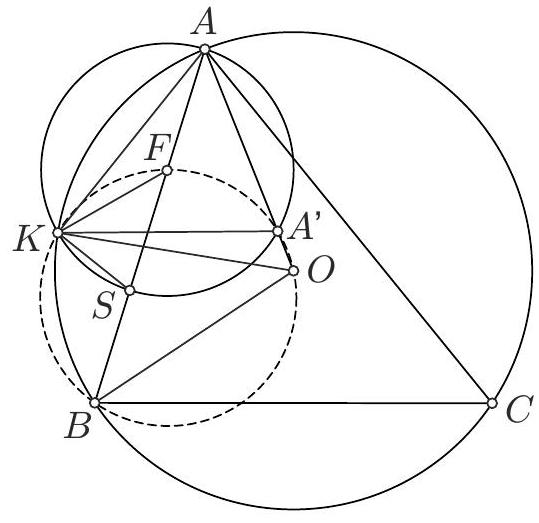
Let be a triangle with . Let and be the feet of the perpendiculars from to the external angle bisectors of and , respectively. Let be the circumcenter of the triangle . Prove that the circumcircles of the triangles and are tangent to each other.
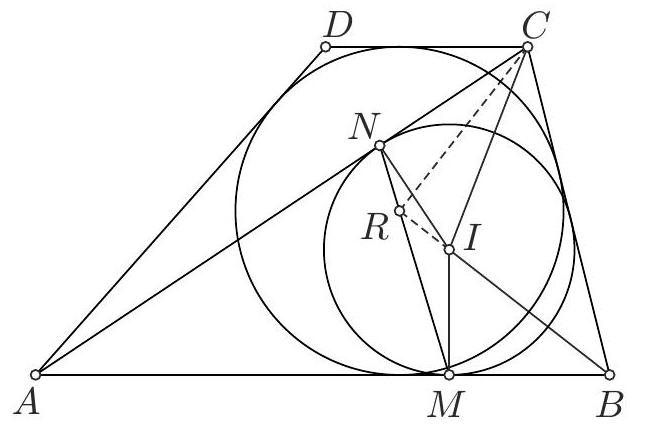
A trapezoid is circumscribed. The incircle of triangle touches the lines and at and , respectively. Prove that the incenter of the trapezoid lies on the line .
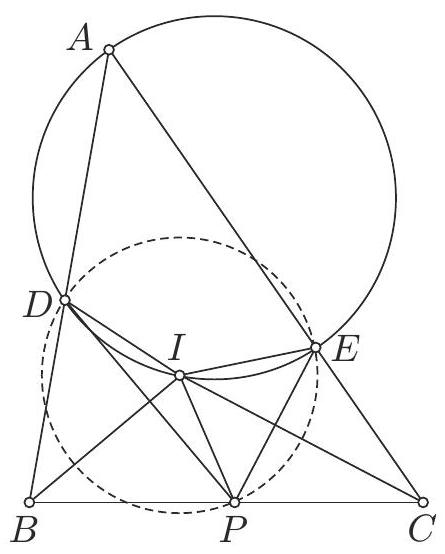
Let be an acute angled triangle whose shortest side is . Consider a variable point on the side , and let and be points on and , respectively, such that and . Prove that, as traces , the circumcircle of the triangle passes through a fixed point.
Let be an acute angled triangle with orthocenter and circumcenter . Assume the circumcenter of lies on the circumcircle of . Reflect across to obtain , and let the lines and meet at . Let and be the midpoints of and , respectively. Prove that the points and are cocyclic.
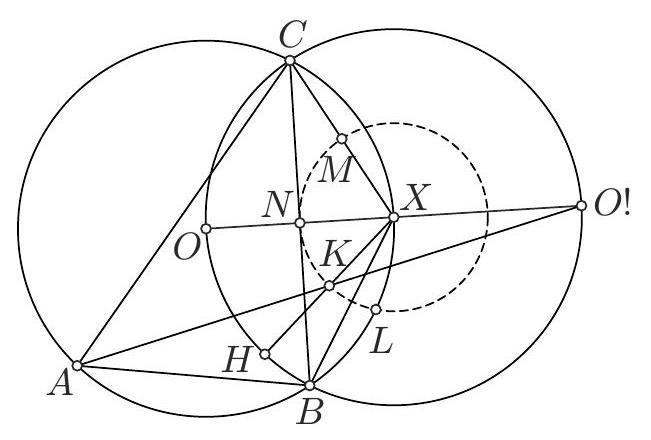
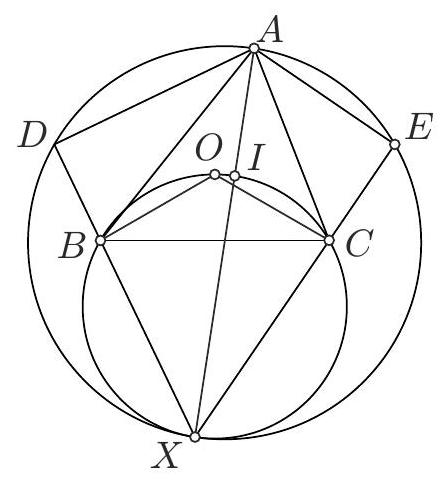
Given an acute triangle , erect triangles and externally, so that and . Let and be the feet of the altitudes of the triangle , and let and be the midpoints of and , respectively. Prove that the circumcenters of the triangles and are collinear.
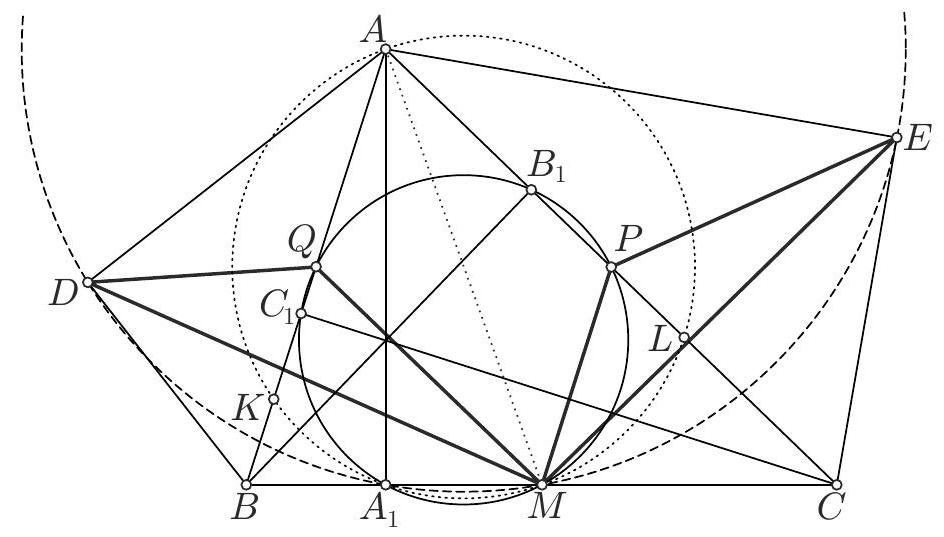
Let be a chord of a circle centered at , and let be a point on the segment such that . Two circles through , internally tangent to (c) at and , respectively, meet again at . Let be one of the points of intersection of the line and the circle (c), and let the lines and meet at . Prove that the line is tangent to the circle .
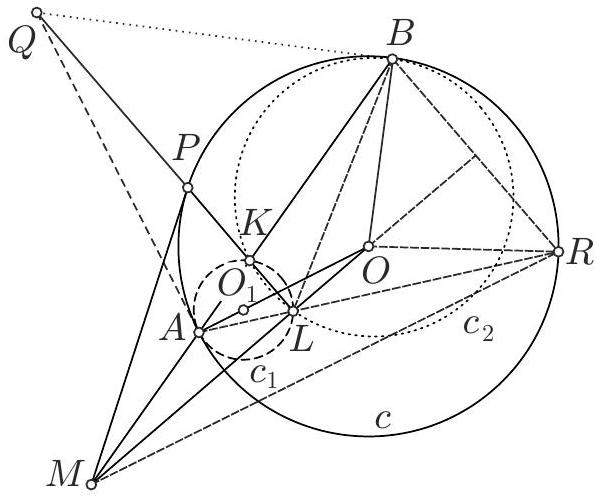
Determine the largest positive integer that divides for all primes .
Find the maximum number of natural numbers satisfying the conditions:
a) No is divisible by 11 ; and
b) The sum is divisible by 11 .
Find all positive integers such that the number is
a) an integer;
b) a prime.
Find all triples of integers such that the number
is a power of 2016 .
Determine all four-digit numbers such that