Let be an infinite sequence of positive integers. Prove that there exists a unique integer such that (Austria)
ISL 2014
IMO Shortlist 2014.
Other problems
Define the function by Let and be two real numbers such that . We define the sequences and by , and for . Show that there exists a positive integer such that (Denmark)
For a sequence of real numbers, we define its price as Given real numbers, Dave and George want to arrange them into a sequence with a low price. Diligent Dave checks all possible ways and finds the minimum possible price . Greedy George, on the other hand, chooses such that is as small as possible; among the remaining numbers, he chooses such that is as small as possible, and so on. Thus, in the step he chooses among the remaining numbers so as to minimise the value of . In each step, if several numbers provide the same value, George chooses one at random. Finally he gets a sequence with price . Find the least possible constant such that for every positive integer , for every collection of real numbers, and for every possible sequence that George might obtain, the resulting values satisfy the inequality . (Georgia)
Determine all functions satisfying for all integers and .
Consider all polynomials with real coefficients that have the following property: for any two real numbers and one has Determine all possible values of .
Find all functions such that for all . (United Kingdom)
Let points be given inside a rectangle such that no two of them lie on a line parallel to one of the sides of . The rectangle is to be dissected into smaller rectangles with sides parallel to the sides of in such a way that none of these rectangles contains any of the given points in its interior. Prove that we have to dissect into at least smaller rectangles. (Serbia)
We have sheets of paper, with the number 1 written on each of them. We perform the following operation. In every step we choose two distinct sheets; if the numbers on the two sheets are and , then we erase these numbers and write the number on both sheets. Prove that after steps, the sum of the numbers on all the sheets is at least . (Iran)
Let be an integer. Consider an chessboard divided into unit squares. We call a configuration of rooks on this board happy if every row and every column contains exactly one rook. Find the greatest positive integer such that for every happy configuration of rooks, we can find a square without a rook on any of its unit squares. (Croatia)
Construct a tetromino by attaching two dominoes along their longer sides such that the midpoint of the longer side of one domino is a corner of the other domino. This construction yields two kinds of tetrominoes with opposite orientations. Let us call them Sand Z-tetrominoes, respectively. 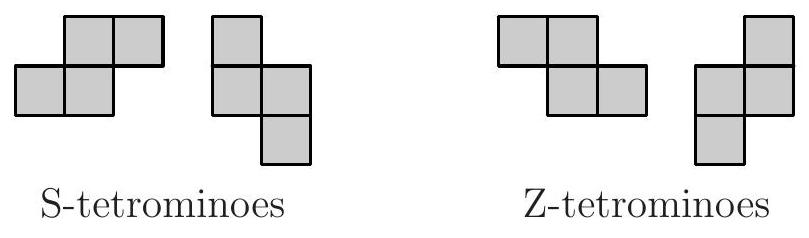 Assume that a lattice polygon can be tiled with S-tetrominoes. Prove than no matter how we tile using only S - and Z -tetrominoes, we always use an even number of Z -tetrominoes. (Hungary)
Consider lines in the plane such that no two lines are parallel and no three have a common point. These lines divide the plane into polygonal regions; let be the set of regions having finite area. Prove that it is possible to colour of the lines blue in such a way that no region in has a completely blue boundary.
We are given an infinite deck of cards, each with a real number on it. For every real number , there is exactly one card in the deck that has written on it. Now two players draw disjoint sets and of 100 cards each from this deck. We would like to define a rule that declares one of them a winner. This rule should satisfy the following conditions: 1. The winner only depends on the relative order of the 200 cards: if the cards are laid down in increasing order face down and we are told which card belongs to which player, but not what numbers are written on them, we can still decide the winner. 2. If we write the elements of both sets in increasing order as and , and for all , then beats . 3. If three players draw three disjoint sets from the deck, beats and beats , then also beats . How many ways are there to define such a rule? Here, we consider two rules as different if there exist two sets and such that beats according to one rule, but beats according to the other. (Russia)
Let be a set of points in the plane, no three of which are collinear. Initially these points are connected with segments so that each point in is the endpoint of exactly two segments. Then, at each step, one may choose two segments and sharing a common interior point and replace them by the segments and if none of them is present at this moment. Prove that it is impossible to perform or more such moves. (Russia)
A card deck consists of 1024 cards. On each card, a set of distinct decimal digits is written in such a way that no two of these sets coincide (thus, one of the cards is empty). Two players alternately take cards from the deck, one card per turn. After the deck is empty, each player checks if he can throw out one of his cards so that each of the ten digits occurs on an even number of his remaining cards. If one player can do this but the other one cannot, the one who can is the winner; otherwise a draw is declared. Determine all possible first moves of the first player after which he has a winning strategy. (Russia)
There are circles drawn on a piece of paper in such a way that any two circles intersect in two points, and no three circles pass through the same point. Turbo the snail slides along the circles in the following fashion. Initially he moves on one of the circles in clockwise direction. Turbo always keeps sliding along the current circle until he reaches an intersection with another circle. Then he continues his journey on this new circle and also changes the direction of moving, i.e. from clockwise to anticlockwise or vice versa. Suppose that Turbo's path entirely covers all circles. Prove that must be odd.
The points and are chosen on the side of an acute-angled triangle so that and . The points and are taken on the rays and , respectively, so that and . Prove that the lines and intersect on the circumcircle of the triangle . (Georgia)
Let be a triangle. The points , and lie on the segments , and , respectively, such that the lines , and intersect in a common point. Prove that it is possible to choose two of the triangles , and whose inradii sum up to at least the inradius of the triangle . (Estonia)
Let and be the circumcircle and the circumcentre of an acute-angled triangle with . The angle bisector of intersects at . Let be the circle with diameter . The angle bisectors of and intersect at points and , respectively. The point is chosen on the line so that . Prove that . (Russia)
Consider a fixed circle with three fixed points , and on it. Also, let us fix a real number . For a variable point on , let be the point on the segment such that . Let be the second point of intersection of the circumcircles of the triangles and . Prove that as varies, the point lies on a fixed circle. (United Kingdom)
Let be a convex quadrilateral with . Point is the foot of the perpendicular from to . The points and are chosen on the sides and , respectively, in such a way that lies inside triangle and Prove that the circumcircle of triangle is tangent to the line . (Iran)
Let be a fixed acute-angled triangle. Consider some points and lying on the sides and , respectively, and let be the midpoint of . Let the perpendicular bisector of intersect the line at , and let the perpendicular bisector of intersect the lines and at and , respectively. We call the pair interesting, if the quadrilateral is cyclic. Suppose that the pairs and are interesting. Prove that (Iran)
Let be a triangle with circumcircle and incentre . Let the line passing through and perpendicular to intersect the segment and the not containing of at points and , respectively. Let the line passing through and parallel to intersect at , and let the line passing through and parallel to intersect at . Let and be the midpoints of and , respectively. Prove that if the points , and are collinear, then the points , and are also collinear.
Let be an integer, and let be the set Determine the largest positive integer that cannot be written as the sum of one or more (not necessarily distinct) elements of . (Serbia)
Determine all pairs of positive integers such that
A coin is called a Cape Town coin if its value is for some positive integer . Given a collection of Cape Town coins of total value at most , prove that it is possible to split this collection into at most 100 groups each of total value at most 1. (Luxembourg)
Let be a given integer. Prove that infinitely many terms of the sequence , defined by are odd. (For a real number denotes the largest integer not exceeding .) (Hong Kong)
Find all triples consisting of a prime number and two positive integers and such that and are both powers of . (Belgium)
Let be pairwise coprime positive integers with being prime and . On the segment of the real line, mark all integers that are divisible by at least one of the numbers . These points split into a number of smaller segments. Prove that the sum of the squares of the lengths of these segments is divisible by . (Serbia)
Let be an integer. Define a sequence of positive integers by and for all . Prove that for each integer there exists a prime number dividing but none of the numbers . (Austria)
For every real number , let denote the distance between and the nearest integer. Prove that for every pair of positive integers there exist an odd prime and a positive integer satisfying (Hungary)