Determine all functions such that the equality holds for all . Here, by we denote the greatest integer not exceeding . (France)
ISL 2010
IMO Shortlist 2010.
Other problems
Let the real numbers satisfy the relations and . Prove that (Ukraine)
Let be nonnegative real numbers such that for all (we put ). Find the maximal possible value of the sum (Russia)
A sequence is defined by and for all . Prove that for all . (Austria)
Denote by the set of all positive rational numbers. Determine all functions which satisfy the following equation for all : (Switzerland)
Suppose that and are two functions defined on the set of positive integers and taking positive integer values. Suppose also that the equations and hold for all positive integers. Prove that for all positive integer . (Germany)
Let be positive real numbers. For , we inductively define Prove that there exist positive integers and such that for all . (Iran)
Given six positive numbers such that . Let and . Prove that (South Korea)
In a concert, 20 singers will perform. For each singer, there is a (possibly empty) set of other singers such that he wishes to perform later than all the singers from that set. Can it happen that there are exactly 2010 orders of the singers such that all their wishes are satisfied? (Austria)
On some planet, there are countries . Each country has a flag units wide and one unit high composed of fields of size , each field being either yellow or blue. No two countries have the same flag. We say that a set of flags is diverse if these flags can be arranged into an square so that all fields on its main diagonal will have the same color. Determine the smallest positive integer such that among any distinct flags, there exist flags forming a diverse set. (Croatia)
2500 chess kings have to be placed on a chessboard so that (i) no king can capture any other one (i.e. no two kings are placed in two squares sharing a common vertex); (ii) each row and each column contains exactly 25 kings. Find the number of such arrangements. (Two arrangements differing by rotation or symmetry are supposed to be different.) (Russia)
Six stacks of coins are standing in a row. In the beginning every stack contains a single coin. There are two types of allowed moves: Move 1: If stack with contains at least one coin, you may remove one coin from and add two coins to . Move 2: If stack with contains at least one coin, then you may remove one coin from and exchange stacks and . Decide whether it is possible to achieve by a sequence of such moves that the first five stacks are empty, whereas the sixth stack contains exactly coins. Same as Problem C4, but the constant is replaced by . (Netherlands)
players participated in a tennis tournament. Any two players have played exactly one game, and there was no tie game. We call a company of four players bad if one player was defeated by the other three players, and each of these three players won a game and lost another game among themselves. Suppose that there is no bad company in this tournament. Let and be respectively the number of wins and losses of the th player. Prove that (South Korea)
Given a positive integer and other two integers . There are two strings of pearls, a string of black pearls and a string of white pearls. The length of a string is the number of pearls on it. One cuts these strings in some steps by the following rules. In each step: (i) The strings are ordered by their lengths in a non-increasing order. If there are some strings of equal lengths, then the white ones precede the black ones. Then first ones (if they consist of more than one pearl) are chosen; if there are less than strings longer than 1 , then one chooses all of them. (ii) Next, one cuts each chosen string into two parts differing in length by at most one. (For instance, if there are strings of black pearls, strings of white pearls and , then the strings of 8 white, 5 black, 4 white and 4 black pearls are cut into the parts and , respectively.) The process stops immediately after the step when a first isolated white pearl appears. Prove that at this stage, there will still exist a string of at least two black pearls. (Canada)
Let be arithmetic progressions of integers, the following conditions being satisfied: (i) each integer belongs to at least one of them; (ii) each progression contains a number which does not belong to other progressions. Denote by the least common multiple of steps of these progressions; let be its prime factorization. Prove that (Germany)
Let be an acute triangle with the feet of the altitudes lying on respectively. One of the intersection points of the line and the circumcircle is . The lines and meet at point . Prove that . (United Kingdom)
Point lies inside triangle . Lines meet the circumcircle of again at points , respectively. The tangent to the circumcircle at meets line at . Prove that if and only if .
Let be a convex polygon. Point inside this polygon is chosen so that its projections onto lines respectively lie on the sides of the polygon. Prove that for arbitrary points on sides respectively, (Armenia)
Let be the incenter of a triangle and be its circumcircle. Let the line intersect at a point . Let and be points on side and respectively such that . Finally, let be the midpoint of the segment . Prove that the lines and intersect on . (Hong Kong)
Let be a convex pentagon such that , and . Let be the midpoint of , and let be the circumcenter of triangle . Given that , prove that . (Ukraine)
The vertices of an equilateral triangle lie respectively on the sides , of an acute-angled triangle . Prove that the incenter of triangle lies inside triangle .
Three circular arcs , and connect the points and . These arcs lie in the same half-plane defined by line in such a way that arc lies between the arcs and . Point lies on the segment . Let , and be three rays starting at , lying in the same half-plane, being between and . For , denote by the point of intersection of and (see the Figure below). Denote by the curved quadrilateral, whose sides are the segments and and . We say that this quadrilateral is circumscribed if there exists a circle touching these two segments and two arcs. Prove that if the curved quadrilaterals are circumscribed, then the curved quadrilateral is circumscribed, too. 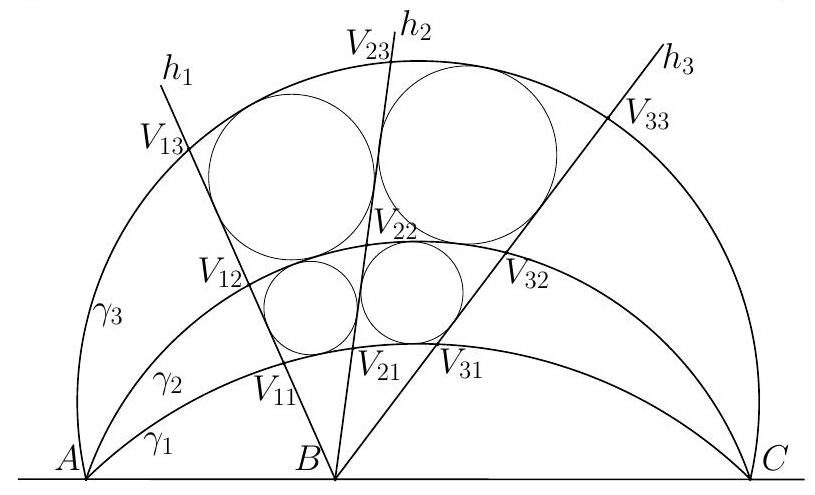 Fig. 1 (Hungary)
Find the least positive integer for which there exists a set consisting of distinct positive integers such that . Same as Problem N1, but the constant is replaced by . (Canada) Answer for Problem N1. . Solution for Problem N1. Suppose that for some there exist the desired numbers; we may assume that . Surely since otherwise . So we have , hence for each . Therefore which implies so . Now we are left to show that fits. Consider the set which contains exactly 39 numbers. We have hence for there exists a desired example. Comment. One can show that the example (1) is unique. Answer for Problem N1' . Solution for Problem N1'. Suppose that for some there exist the desired numbers. In the same way we obtain that . Moreover, since the denominator of the fraction is divisible by 67 , some of 's should be divisible by 67 , so . This means that which implies so . Now we are left to show that fits. Consider the set which contains exactly 48 numbers. We have hence for there exists a desired example. Comment 1. In this version of the problem, the estimate needs one more step, hence it is a bit harder. On the other hand, the example in this version is not unique. Another example is Comment 2. N1' was the Proposer's formulation of the problem. We propose N1 according to the number of current IMO.
Find all pairs of nonnegative integers for which (Australia)
Find the smallest number such that there exist polynomials with rational coefficients satisfying (Poland)
Let be integers, and let . For any positive integer we say that the pair is -good if implies for all integers . We say that is very good if is -good for infinitely many positive integers . (a) Find a pair which is 51 -good, but not very good. (b) Show that all 2010-good pairs are very good. (Turkey)
Let be the set of all positive integers. Find all functions such that the number is a square for all .
The rows and columns of a table are numbered from 0 to . The cells of the table have been colored with the following property being satisfied: for each , the th cell in the th row and the 2^{n}$.