Let and be two consecutive odd prime numbers. Prove that is a product of at least three positive integers greater than 1 (not necessarily different).
BALTIC-WAY 1992
Baltic Way 1992.
Other problems
Denote by the number of all positive divisors of a positive integer (including 1 and ). Prove that there are infinitely many such that is an integer.
Find an infinite non-constant arithmetic progression of positive integers such that each term is neither a sum of two squares, nor a sum of two cubes (of positive integers).
Is it possible to draw a hexagon with vertices in the knots of an integer lattice so that the squares of the lengths of the sides are six consecutive positive integers?
Given that , prove that .
Prove that the product of the 99 numbers of the form where , is greater than .
Let . Which number is greater:
or 1992 ?
Find all integers satisfying the equation .
A polynomial is such that and . Prove that the polynomial has three different real roots.
Find all fourth degree polynomials such that the following four conditions are satisfied:
(i) for all .
(ii) for all .
(iii) .
(iv) has exactly two local minimum points and such that .
Let denote the set of positive rational numbers. Show that there exists one and only one function satisfying the following conditions:
(i) If then .
(ii) If then .
(iii) for all .
Let denote the set of positive integers. Let be a bijective function and assume that there exists a finite limit
What are the possible values of ?
Prove that for any positive and the inequality
holds.
There is a finite number of towns in a country. They are connected by one direction roads. It is known that, for any two towns, one of them can be reached from the other one. Prove that there is a town such that all the remaining towns can be reached from it.
Noah has to fit 8 species of animals into 4 cages of the ark. He plans to put species in each cage. It turns out that, for each species, there are at most 3 other species with which it cannot share the accommodation. Prove that there is a way to assign the animals to their cages so that each species shares a cage with compatible species.
All faces of a convex polyhedron are parallelograms. Can the polyhedron have exactly 1992 faces?
Quadrangle is inscribed in a circle with radius 1 in such a way that one diagonal, , is a diameter of the circle, while the other diagonal, , is as long as . The diagonals intersect in . It is known that the length of is . How long is the side ?
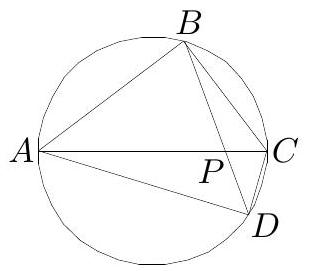
Figure 1
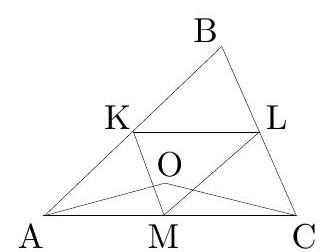
Figure 2
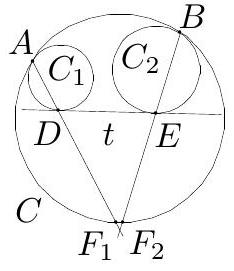
Figure 3
Show that in a non-obtuse triangle the perimeter of the triangle is always greater than two times the diameter of the circumcircle.
Let be a circle in the plane. Let and be non-intersecting circles touching internally at points and respectively. Let be a common tangent of and , touching them at points and respectively, such that both and are on the same side of . Let be the point of intersection of and . Show that lies on .
Let be the sides of a right triangle, and let be its perimeter. Show that
where is the area of the triangle.