Determine all integers satisfying the identities:
JBMO Shortlist 2009.
Determine all integers satisfying the identities:
Find the maximum value of , if satisfies the conditions:
Find all values of the real parameter , for which the system
has exactly three solutions.
Real numbers satisfy
and
Show that
Let be positive real numbers. Prove that:
Each one of 2009 distinct points in the plane is coloured in blue or red, so that on every blue-centered unit circle there are exactly two red points. Find the gratest possible number of blue points.
Five players take part in a bridge tournament. Every two players must play (as partners) against every other two players. Any two given players can be partners not more than once per day. What is the least number of days needed for this tournament?
a) In how many ways can we read the word SARAJEVO from the table below, if it is allowed to jump from cell to an adjacent cell (by vertex or a side) cell?
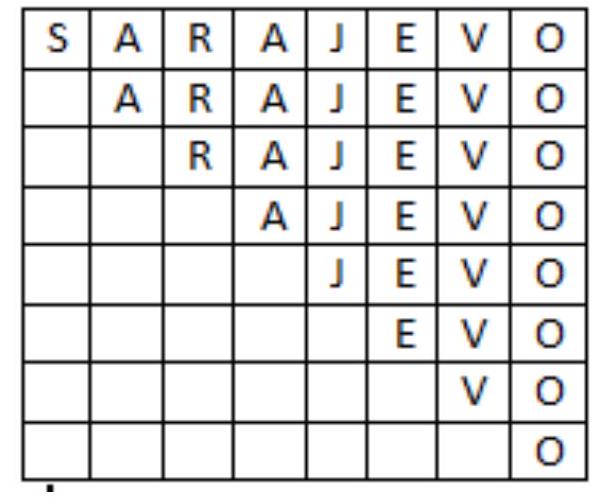
b) After the letter in one cell was deleted, only 525 ways to read the word SARAJEVO remained. Find all possible positions of that cell.
Determine all pairs for which it is possible to tile the table with "corners" as in the figure below, with the condition that in the tiling there is no rectangle (except for the one) regularly covered with corners.

Let be a parallelogram with , and let be the point of intersection of and . The circle with center at and radius intersects the extensions of and at points and , respectively. Let be intersection point of lines and . Prove that .
In a right trapezoid the angle at vertex measures . Point is the foot of the perpendicular from point to the line . If and , find the area of .
A parallelogram with obtuse angle is given. After rotating the triangle around the vertex , we get a triangle , such that points and are collinear. The extension of the median of triangle that passes through intersects the straight line at point . Prove that is the bisector of the angle .
Let be a convex pentagon such that and let be a semicircle with center on side that touches the sides and of the pentagon, respectively, at points and (different from the vertices of the pentagon). Prove that .
Let and be four points in the plane, such that and . Define the point and the line such that and . Line cuts at and the circumcircle of at . Prove that the circumcircles of triangles and are tangent at .