If for the real numbers the following conditions are valid, and , find the product .
JBMO-SL 2008
JBMO Shortlist 2008.
Other problems
Find all real numbers such that and 150 .
Let the real parameter be such that the system
has at least three different real solutions. Find and solve the system for that .
Find all triples of real numbers that satisfy the system
Find all triples of real positive numbers, which satisfy the system
If the real numbers are such that , show that
Let and be a positive real numbers such that . Prove the inequality
Show that
for any real positive numbers and .
Consider an integer and a sequence of real numbers . An operation consists in eliminating all numbers not having the rank of the form , thus leaving only the numbers (for example, the sequence produces the sequence 9,1 . Upon the sequence the operation is performed successively for 5 times. Show that at the end only 1 number remains and find this number.
On a board, white markers are positioned, each marker in a distinct square. A smart child got an assignment to recolor in black as many markers as possible, in the following manner: a white marker is taken from the board; it is colored in black, and then put back on the board on an empty square such that none of the neighboring squares contains a white marker (two squares are called neighboring if they contain a common side). If it is possible for the child to succeed in coloring all the markers black, we say that the initial positioning of the markers was good.
a) Prove that if , then a good initial positioning exists.
b) Prove that if , then a good initial positioning does not exist.
Kostas and Helene have the following dialogue:
Kostas: I have in my mind three positive real numbers with product 1 and sum equal to the sum of all their pairwise products.
Helene: I think that I know the numbers you have in mind. They are all equal to 1.
Kostas: In fact, the numbers you mentioned satisfy my conditions, but I did not think of these numbers. The numbers you mentioned have the minimal sum between all possible solutions of the problem.
Can you decide if Kostas is right? (Explain your answer).
Integers are arbitrarily assigned to boxes labeled with numbers . Now, we add the number assigned to the box to the number on the box label. Show that two such sums give the same remainder modulo .
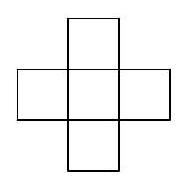
Every cell of table is colored into white. It is permitted to place the cross (pictured below) on the table such that its center lies on the table (the whole figure does not need to lie on the table) and change colors of every cell which is covered into opposite (white and black). Find all such that after steps it is possible to get the table with every cell colored black.
Two perpendicular chords of a circle, , which intersect at point , define on the circle four arcs with pairwise different length, with being the smallest of them.
We draw the chords with and different from . If is the point of intersection of and the point of intersection of , prove that .
For a fixed triangle we choose a point on the ray (after ), a point on the ray (after ) and a point on the ray (after ) in a way such that . Prove that the angles of triangle do not depend on the choice of .
The vertices and of an equilateral lie on a circle of radius 1 , and the vertex is inside . The point lies on and the line intersects for the second time in point . Find the length of the segment .
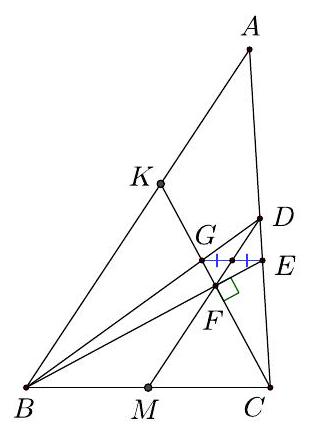
Let be a triangle, . The line passing trough the vertices and orthogonal to the angle bisector of , meets and the median of the side at points and , respectively. Prove that segment bisect the segment .
Is it possible to cover a given square with a few congruent right-angled triangles with acute angle equal to ? (The triangles may not overlap and may not exceed the margins of the square.)
Let be a triangle with . Outside of a triangle we consider isosceles triangles and with bases and , respectively. If the midpoint of the side is such that and , prove that .
Let be an isosceles triangle with . The point lies on the side such that the semicircle with diameter and center is tangent to the side in the point and intersects the side at the point . The radius intersects the chord at the point such that . Find the ratio .
The side lengths of a parallelogram are and diagonals have lengths and , Knowing that , show that
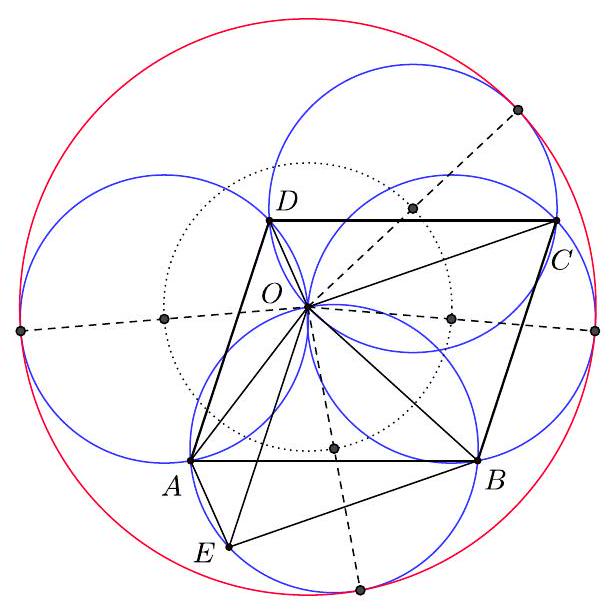
Let be a point inside the parallelogram such that
Prove that there exists a circle tangent to the circumscribed circles of the triangles and .
Let be a circle of center , and be a line in the plane of , not intersecting it. Denote by the foot of the perpendicular from onto , and let be a (variable) point on . Denote by the circle of diameter , by the (other than ) intersection point of and , and by the (other than ) intersection point of and . Prove that the line passes through a fixed point.
Consider an acute-angled triangle with . Denote by the midpoint of , by the feet of the altitudes from respectively and let be the intersection point of the lines and . The perpendicular from to meets the perpendicular from to at point . Prove that lines and are perpendicular.