olymmath

BxMO 2024

Benelux Mathematical Olympiad 2024.

Other problems

Problem 1

(a) Let a0,a1,…,a2024a_{0}, a_{1}, \ldots, a_{2024} be real numbers such that ∣ai+1−ai∣⩽1\left|a_{i+1}-a_{i}\right| \leqslant 1 for i=0,1,…,2023i=0,1, \ldots, 2023.

Find the minimum possible value of

a0a1+a1a2+⋯+a2023a2024a_{0} a_{1}+a_{1} a_{2}+\cdots+a_{2023} a_{2024}

(b) Does there exist a real number CC such that

a0a1−a1a2+a2a3−a3a4+⋯+a2022a2023−a2023a2024⩾Ca_{0} a_{1}-a_{1} a_{2}+a_{2} a_{3}-a_{3} a_{4}+\cdots+a_{2022} a_{2023}-a_{2023} a_{2024} \geqslant C

for all real numbers a0,a1,…,a2024a_{0}, a_{1}, \ldots, a_{2024} such that ∣ai+1−ai∣⩽1\left|a_{i+1}-a_{i}\right| \leqslant 1 for i=0,1,…,2023i=0,1, \ldots, 2023 ?

Problem 2

Let nn be a positive integer. In a coordinate grid, a path from (0,0)(0,0) to (2n,2n)(2 n, 2 n) consists of 4n4 n consecutive unit steps (1,0)(1,0) or (0,1)(0,1). Prove that the number of paths that divide the square with vertices (0,0)(0,0), (2n,0),(2n,2n),(0,2n)(2 n, 0),(2 n, 2 n),(0,2 n) into two regions with even areas is

(4n2n)+(2nn)2\frac{\binom{4 n}{2 n}+\binom{2 n}{n}}{2}

Problem 3

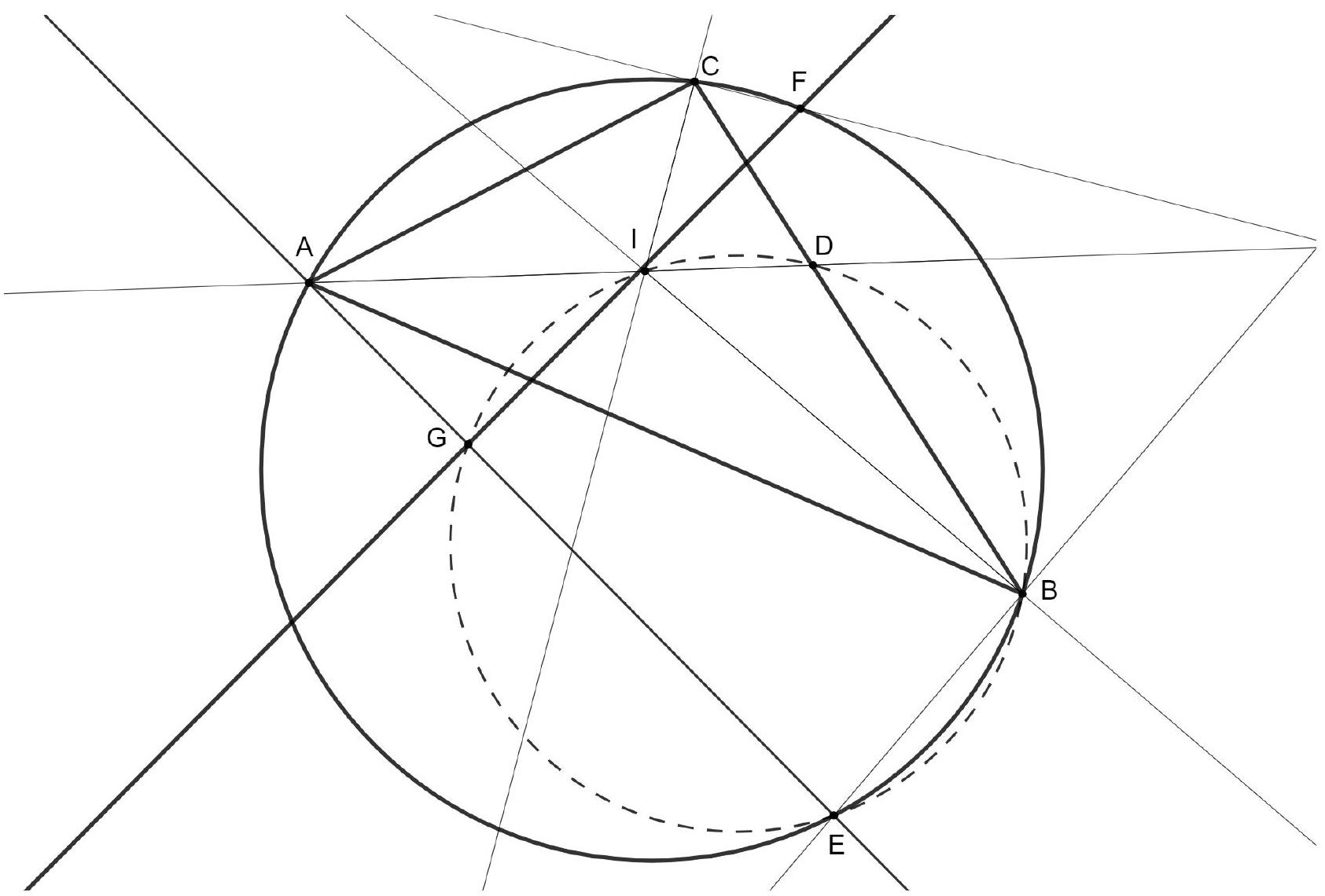
Let ABCA B C be a triangle with incentre II and circumcircle Ω\Omega such that ∣AC∣≠∣BC∣|A C| \neq|B C|. The internal angle bisector of ∠CAB\angle C A B intersects side [BC] in DD, and the external angle bisectors of ∠ABC\angle A B C and ∠BCA\angle B C A intersect Ω\Omega again in EE and FF, respectively. Let GG be the intersection of lines AEA E and FIF I and let Γ\Gamma be the circumcircle of triangle BDIB D I. Show that EE lies on Γ\Gamma if and only if GG lies on Γ\Gamma.

Problem 4

For each positive integer nn, let rad⁡(n)\operatorname{rad}(n) denote the product of the distinct prime factors of nn. Show that there exist integers a,b>1a, b>1 such that gcd⁡(a,b)=1\operatorname{gcd}(a, b)=1 and

rad⁡(ab(a+b))<a+b20242024\operatorname{rad}(a b(a+b))<\frac{a+b}{2024^{2024}}

For example, rad⁡(20)=rad⁡(22⋅5)=2⋅5=10\operatorname{rad}(20)=\operatorname{rad}\left(2^{2} \cdot 5\right)=2 \cdot 5=10 and rad⁡(18)=rad⁡(2⋅32)=2⋅3=6\operatorname{rad}(18)=\operatorname{rad}\left(2 \cdot 3^{2}\right)=2 \cdot 3=6.