Let be an infinite sequence of real numbers satisfying for all positive integers . Show that
holds for all positive integers .
Baltic Way 2017.
Let be an infinite sequence of real numbers satisfying for all positive integers . Show that
holds for all positive integers .
Does there exist a finite set of real numbers such that their sum equals 2 , the sum of their squares equals 3 , the sum of their cubes equals 4 and the sum of their ninth powers equals 10 ?
Positive integers (not necessarily distinct) are written on a blackboard. It is known that each of the numbers can be represented as a sum of one or more of the numbers on the blackboard. What is the smallest possible value of ?
(Here are the first 2018 Fibonacci numbers: for .)
A linear form in variables is an expression of the form with real constants . Prove that there exist a positive integer and linear forms in 2017 variables such that the equation
holds for all real numbers .
Find all functions such that
for all real numbers and .
Fifteen stones are placed on a board, one in each cell, the remaining cell being empty. Whenever two stones are on neighbouring cells (having a common side), one may jump over the other to the opposite neighbouring cell, provided this cell is empty. The stone jumped over is removed from the board.

For which initial positions of the empty cell is it possible to end up with exactly one stone on the board?
Each edge of a complete graph on 30 vertices is coloured either red or blue. It is allowed to choose a nonmonochromatic triangle and change the colour of the two edges of the same colour to make the triangle monochromatic. Prove that by using this operation repeatedly it is possible to make the entire graph monochromatic.
(A complete graph is a graph where any two vertices are connected by an edge.)
A chess knight has injured his leg and is limping. He alternates between a normal move and a short move where he moves to any diagonally neighbouring cell.
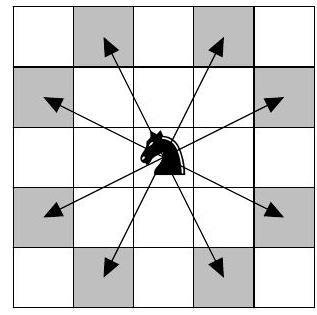
Normal move
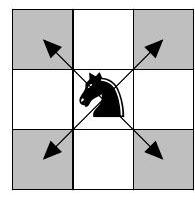
Short move
The limping knight moves on a cell chessboard starting with a normal move. What is the largest number of moves he can make if he is starting from a cell of his own choice and is not allowed to visit any cell (including the initial cell) more than once?
A positive integer is Danish if a regular hexagon can be partitioned into congruent polygons. Prove that there are infinitely many positive integers such that both and are Danish.
Maker and Breaker are building a wall. Maker has a supply of green cubical building blocks, and Breaker has a supply of red ones, all of the same size. On the ground, a row of squares has been marked in chalk as place-holders. Maker and Breaker now take turns in placing a block either directly on one of these squares, or on top of another block already in place, in such a way that the height of each column never exceeds . Maker places the first block.
Maker bets that he can form a green row, i.e. all blocks at a certain height are green. Breaker bets that he can prevent Maker from achieving this. Determine all pairs of positive integers for which Maker can make sure he wins the bet.
Let and be the orthocentre and incentre, respectively, of an acute angled triangle . The circumcircle of the triangle intersects the segment at the point different from . Let be the projection of onto and the reflection of in . Show that and are collinear.
Line touches circle in the point and circle in the point . We draw a line which is parallel to and intersects in a point and in a point . Prove that the ratio does not depend on the choice of .
Let be a triangle in which . Let and be the incentre and circumcentre of , respectively. Let be the midpoint of the arc of the circumcircle of , which does not contain the point . Determine given that .
Let be a point inside the acute angle . Suppose that . The points and are on the segments and , respectively, such that and . The points and are on the segments and , respectively, such that is perpendicular to and is perpendicular to . Show that .
Let be an integer. What is the largest possible number of interior angles greater than in an -gon in the plane, given that the -gon does not intersect itself and all its sides have the same length?
Is it possible for any group of people to choose a positive integer and assign a positive integer to each person in the group such that the product of two persons' numbers is divisible by if and only if they are friends?
Determine whether the equation
has an infinite number of solutions in positive integers.
Let be a prime and let be a permutation of . For which is it always possible to determine the sequence if for all with the residue of modulo is known?
For an integer let denote the total number of carries which arise when adding 2017 and . The first few values are given by , which can be seen from the following:
| 001 | 001 | 000 |
|---|---|---|
| 2017 | 4034 | 6051 |
| +2017 | +2017 | +2017 |
Prove that
Let be the set of all ordered pairs of integers with such that is a multiple of 2017. Prove that