Let be an increasing real function defined for all , satisfying the conditions
Determine and .
Nordic Mathematical Contest 1993.
Let be an increasing real function defined for all , satisfying the conditions
Determine and .
A hexagon is inscribed in a circle of radius . Two of the sides of the hexagon have length 1, two have length 2 and two have length 3. Show that satisfies the equation
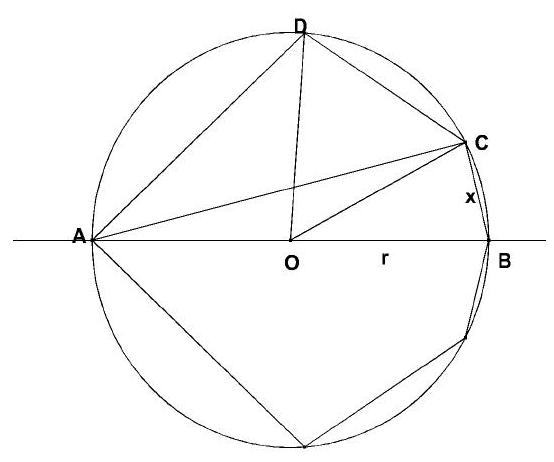
Figure 5.
Find all solutions of the system of equations
where , and are positive integers, and , and are the numbers of digits in the decimal representations of , and , respectively.
Denote by the sum of the digits of the decimal representation of a positive integer .
a) Find an integer , for which is even for all , but is odd. b) Show that no positive integer exists such that is even for all positive integers .