Georg chooses three distinct digits among and writes them down on three cards. When the cards are laid down next to each other, a three-digit number is formed. Georg tells his mother that the sum of the largest and the second-largest number that can be formed in this manner is . Can she figure out which three digits Georg has chosen?
DK-GEORGMOHR 2014
Georg Mohr Contest 2014.
The official paper in 1 language
Other problems
Three gamblers play against each other for money. They each start by placing a pile of one-krone coins on the table, and from this point on the total number of coins on the table does not change. The ratio between the number of coins they start with is . At the end of the game, the ratio of the number of coins they have is in some order. At the end of the game, one of the gamblers has three coins more than at the beginning. How many coins does this gambler have at the end?
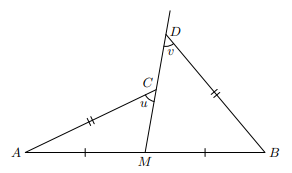
The points and lie on a halfline from the midpoint of a segment , so that . Prove that the angles and are equal.
Determine all positive integers so that both and are perfect squares.
(A perfect square is a number which can be expressed as , where is an integer.)
Let be a sequence of real numbers, which for all satisfy . Determine the largest possible value of the sum .