olymmath

CMO 2005

Canadian Mathematical Olympiad 2005.

Paper

Problem 1

  • Paper
  • Answer

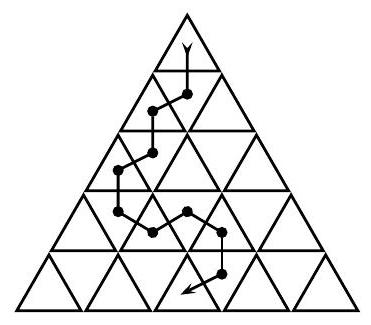
Consider an equilateral triangle of side length nn, which is divided into unit triangles, as shown. Let f(n)f(n) be the number of paths from the triangle in the top row to the middle triangle in the bottom row, such that adjacent triangles in our path share a common edge and the path never travels up (from a lower row to a higher row) or revisits a triangle. An example of one such path is illustrated below for n=5n=5. Determine the value of f(2005)f(2005).

Answer, solutions and source

Problem 2

  • Paper

Let (a,b,c)(a, b, c) be a Pythagorean triple, i.e., a triplet of positive integers with a2+b2=c2a^{2}+b^{2}=c^{2}.

a) Prove that (c/a+c/b)2>8(c / a+c / b)^{2}>8.

b) Prove that there does not exist any integer nn for which we can find a Pythagorean triple (a,b,c)(a, b, c) satisfying (c/a+c/b)2=n(c / a+c / b)^{2}=n.

Answer, solutions and source

Problem 3

  • Paper

Let SS be a set of n≥3n \geq 3 points in the interior of a circle.

a) Show that there are three distinct points a,b,c∈Sa, b, c \in S and three distinct points A,B,CA, B, C on the circle such that aa is (strictly) closer to AA than any other point in S,bS, b is closer to BB than any other point in SS and cc is closer to CC than any other point in SS.

b) Show that for no value of nn can four such points in SS (and corresponding points on the circle) be guaranteed.

Answer, solutions and source

Problem 4

  • Paper
  • Answer

Let ABCA B C be a triangle with circumradius RR, perimeter PP and area KK. Determine the maximum value of KP/R3K P / R^{3}.

Answer, solutions and source

Problem 5

  • Paper
  • Answer

Let's say that an ordered triple of positive integers (a,b,c)(a, b, c) is nn-powerful if a≤b≤ca \leq b \leq c, gcd⁡(a,b,c)=1\operatorname{gcd}(a, b, c)=1, and an+bn+cna^{n}+b^{n}+c^{n} is divisible by a+b+ca+b+c. For example, (1,2,2)(1,2,2) is 5 -powerful.

a) Determine all ordered triples (if any) which are nn-powerful for all n≥1n \geq 1.

b) Determine all ordered triples (if any) which are 2004-powerful and 2005-powerful, but not 2007-powerful.

[Note that gcd⁡(a,b,c)\operatorname{gcd}(a, b, c) is the greatest common divisor of a,ba, b and cc.]

Answer, solutions and source