Find all pairs of primes such that
Baltic Way 2016.
Find all pairs of primes such that
Prove or disprove the following hypotheses.
a) For all , each sequence of consecutive positive integers contains a number that is not divisible by any prime number less than .
b) For all , each sequence of consecutive positive integers contains a number that is relatively prime to all other members of the sequence.
For which integers does the equation
have a solution in integers?
Let be a positive integer and let be integers such that and . Show that
Let be a prime such that . Given a positive integer , define the sequence of integers by for all Prove that it is possible to choose such that the subsequence is not constant modulo for any positive integer .
The set is partitioned into three subsets and . For each subset the sum of its elements, the product of its elements and the sum of the digits of all its elements are calculated. Is it possible that alone has the largest sum of elements, alone has the largest product of elements, and alone has the largest sum of digits?
Find all positive integers for which
holds for all real numbers .
Find all real numbers a for which there exists a non-constant function satisfying the following two equations for all : i) and
ii) .
Find all quadruples of real numbers that simultaneously satisfy the following equations:
Let be positive real numbers. For and set
Show that .
The set consists of 2016 positive integers. All prime divisors of these numbers are smaller than 30. Prove that there are four distinct numbers and in such that abcd is a perfect square.
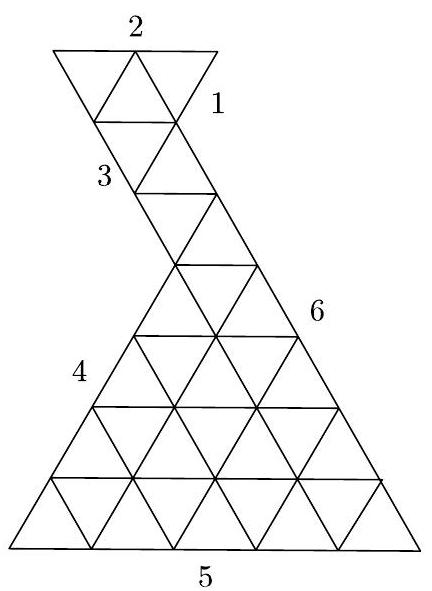
Does there exist a hexagon (not necessarily convex) with side lengths 1, 2, 3, 4, 5, 6 (not necessarily in this order) that can be tiled with a) 31 b) 32 equilateral triangles with side length 1 ?
Let numbers all equal to 1 be written on a blackboard. A move consists of replacing two numbers on
 the board with two copies of their sum. It happens that after moves all numbers on the blackboard are equal to . Prove that .
A cube consists of unit cubes each containing an integer. At each move, you choose a unit cube and increase by 1 all the integers in the neighbouring cubes having a face in common with the chosen cube. Is it possible to reach a position where all the integers are divisible by 3 , no matter what the starting position is?
The Baltic Sea has 2016 harbours. There are two-way ferry connections between some of them. It is impossible to make a sequence of direct voyages where all the harbours are distinct. Prove that there exist two disjoint sets and of 477 harbours each, such that there is no harbour in with a direct ferry connection to a harbour in .
In triangle , the points and are the intersections of the angular bisectors from and with the sides and , respectively. Points and on the extensions of and beyond and , respectively, satisfy . Prove that .
Let be a convex quadrilateral with . Let be a point on the diagonal such that . Prove that .
Let be a parallelogram such that . Let and be the midpoints of and , respectively. Assuming that is a cyclic quadrilateral, find .
Consider triangles in the plane where each vertex has integer coordinates. Such a triangle can be legally transformed by moving one vertex parallel to the opposite side to a different point with integer coordinates. Show that if two triangles have the same area, then there exists a series of legal transformations that transforms one to the other.
Let be a cyclic quadrilateral with and not parallel. Let be the midpoint of . Let be a point inside such that . Prove that and the perpendicular bisector of are concurrent.