Determine all polynomials with real coefficients such that
and
Baltic Way 2008.
Determine all polynomials with real coefficients such that
and
Prove that if the real numbers and satisfy then
When does equality hold?
Does there exist an angle such that and , taken in some order, are consecutive terms of an arithmetic progression?
The polynomial has integer coefficients and for five different integers . Show that there is no integer such that or .
Suppose that Romeo and Juliet each have a regular tetrahedron to the vertices of which some positive real numbers are assigned. They associate each edge of their tetrahedra with the product of the two numbers assigned to its end points. Then they write on each face of their tetrahedra the sum of the three numbers associated to its three edges. The four numbers written on the faces of Romeo's tetrahedron turn out to coincide with the four numbers written on Juliet's tetrahedron. Does it follow that the four numbers assigned to the vertices of Romeo's tetrahedron are identical to the four numbers assigned to the vertices of Juliet's tetrahedron?
Find all finite sets of positive integers with at least two elements such that for any two numbers belonging to the set, the number belongs to the set, too.
How many pairs of positive integers with fulfill the equation
Consider a set of positive integers such that the least element of equals 1001 and the product of all elements of is a perfect square. What is the least possible value of the greatest element of ?
Suppose that the positive integers and satisfy the equation
Prove that and are congruent modulo 1008.
For a positive integer , let denote the sum of its digits. Find the largest possible value of the expression .
Consider a subset of 84 elements of the set such that no two elements in the set add up to 169 . Show that contains a perfect square.
In a school class with children, any two children make a common present to exactly one other child. Prove that for all odd it is possible that the following holds:
For any three children and in the class, if and make a present to then and make a present to .
For an upcoming international mathematics contest, the participating countries were asked to choose from nine combinatorics problems. Given how hard it usually is to agree, nobody was surprised that the following happened:
Find the maximal possible number of participating countries.
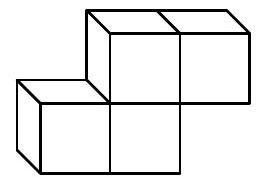
Is it possible to build a cube from blocks of the following shape consisting of 4 unit cubes?
Some dominoes, each covering two adjacent unit squares, are placed on a board of size so that no two of them touch (not even at a corner). Given that the total area covered by the dominoes is 2008 , find the least possible value of .
Let be a parallelogram. The circle with diameter intersects the line at points and . The perpendicular to the line passing through the point intersects the lines and at points and , respectively. Prove that the points and lie on the same circle.
Assume that and are the sides of a quadrilateral inscribed in a given circle. Prove that the product acquires its maximum when the quadrilateral is a square.
Let be a diameter of a circle , and let be the tangent at . Furthermore, let be a fixed, positive real, and consider all pairs of points and lying on , on opposite sides of , such that . The lines and intersect at points and , respectively. Show that all the lines pass through a common point.
In a circle of diameter 1, some chords are drawn. The sum of their lengths is greater than 19. Prove that there is a diameter intersecting at least 7 chords.
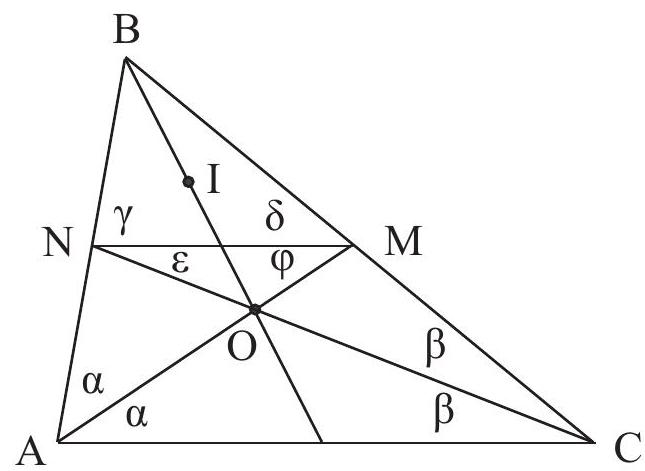
Let be a point on and be a point on such that and are angle bisectors of the triangle . Given that
prove that the triangle is isosceles.