Determine all functions from the real numbers to the real numbers, different from the zero function, such that for all real numbers and .
BALTIC-WAY 1997
Baltic Way 1997.
Other problems
Given a sequence of positive integers in which every positive integer occurs exactly once. Prove that there exist integers and , , such that .
Let and for , where denotes the largest integer not greater than . Determine .
Prove that the arithmetic mean of satisfies
In a sequence of positive integers, is arbitrary, and for any non-negative integer ,
where is a fixed odd positive integer. Prove that the sequence is periodic from a certain step.
Find all triples of non-negative integers satisfying and .
Let and be polynomials with integer coefficients. Suppose that the integers and are roots of , and that . Prove that the equation has no integer solutions.
If we add 1996 and 1997, we first add the unit digits 6 and 7. Obtaining 13, we write down 3 and "carry" 1 to the next column. Thus we make a carry. Continuing, we see that we are to make three carries in total:
Does there exist a positive integer such that adding to no carry arises during the whole calculation?
The worlds in the Worlds' Sphere are numbered and connected so that for any integer , Gandalf the Wizard can move in both directions between any worlds with numbers and . Starting his travel from an arbitrary world, can Gandalf reach every other world?
Prove that in every sequence of 79 consecutive positive integers written in the decimal system, there is a positive integer whose sum of digits is divisible by 13 .
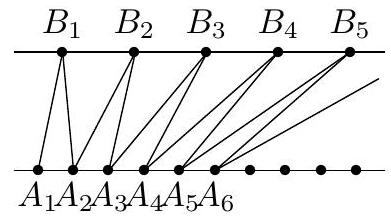
On two parallel lines, the distinct points respectively , are marked in such a way that and for (see Figure). Provided that , find the infinite sum
Two circles and intersect in and . A line through intersects and again in and , respectively, and is the midpoint of . The line through and intersects and again in and , respectively. Prove that is the midpoint of .
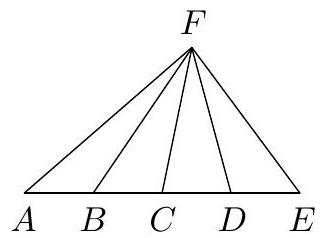
Five distinct points and lie on a line with
The point lies outside the line. Let be the circumcentre of triangle and be the circumcentre of triangle . Show that lines and are perpendicular.
In the triangle is the arithmetic mean of and . Show that .
In the acute triangle , the bisectors of and intersect the circumcircle again in and , respectively. Let be the point of intersection of and , and let be the point of intersection of and . Prove that passes through the incentre of triangle .
On a chessboard, two players play the following game. The first player places a knight on some square. Then the players alternately move the knight according to the rules of chess, starting with the second player. It is not allowed to move the knight to a square that has been visited previously. The player who cannot move loses. Which of the two players has a winning strategy?
A rectangle can be divided into equal squares. The same rectangle can also be divided into equal squares. Find all possible values of .
a) Prove the existence of two infinite sets and , not necessarily disjoint, of non-negative integers such that each non-negative integer is uniquely representable in the form with .
b) Prove that for each such pair , either or contains only multiples of some integer .
In a forest each of animals lives in its own cave, and there is exactly one separate path between any two of these caves. Before the election for King of the Forest some of the animals make an election campaign. Each campaign-making animal visits each of the other caves exactly once, uses only the paths for moving from cave to cave, never turns from one path to another between the caves and returns to its own cave in the end of its campaign. It is also known that no path between two caves is used by more than one campaign-making animal.
a) Prove that for any prime , the maximum possible number of campaign-making animals is ;
b) Find the maximum number of campaign-making animals for .
Twelve cards lie in a row. The cards are of three kinds: with both sides white, both sides black, or with a white and a black side. Initially, nine of the twelve cards have a black side up. The cards 1-6 are turned, and subsequently four of the twelve cards have a black side up. Now cards are turned, and six cards have a black side up. Finally, the cards 1-3 and 10-12 are turned, after which five cards have a black side up. How many cards of each kind are there?