Find all triples of positive integers satisfying the system of equations
Baltic Way 1995.
Find all triples of positive integers satisfying the system of equations
Let and be positive integers such that divides . Prove that .
The positive integers are pairwise relatively prime, and are odd and the numbers satisfy the equation . Prove that is a square of an integer.
John is older than Mary. He notices that if he switches the two digits of his age (an integer), he gets Mary's age. Moreover, the difference between the squares of their ages is the square of an integer. How old are Mary and John?
Let be three positive integers. Prove that among any consecutive positive integers there exist three different numbers such that divides .
Prove that for positive
Prove that .
The real numbers and satisfy the inequalities and . Prove that .
Prove that
Find all real-valued functions defined on the set of all non-zero real numbers such that:
(i) ,
(ii) for all non-zero ,
(iii) for all non-zero .
In how many ways can the set of integers be partitioned into three nonempty sets so that none of these sets contains two consecutive integers?
Assume we have 95 boxes and 19 balls distributed in these boxes in an arbitrary manner. We take six new balls at a time and place them in six of the boxes, one ball in each of the six. Can we, by repeating this process a suitable number of times, achieve a situation in which each of the 95 boxes contains an equal number of balls?
Consider the following two person game. A number of pebbles are situated on the table. Two players make their moves alternately. A move consists of taking off the table pebbles where is the square of any positive integer. The player who is unable to make a move loses. Prove that there are infinitely many initial situations in which the second player can win no matter how his opponent plays.
There are fleas on an infinite sheet of triangulated paper. Initially the fleas are in different small triangles, all of which are inside some equilateral triangle consisting of small triangles (see Figure 1 for a possible initial configuration with ). Once a second each flea jumps from its triangle to one of the three small triangles as indicated in the figure. For which positive integers does there exist an initial configuration such that after a finite number of jumps all the fleas can meet in a single small triangle?
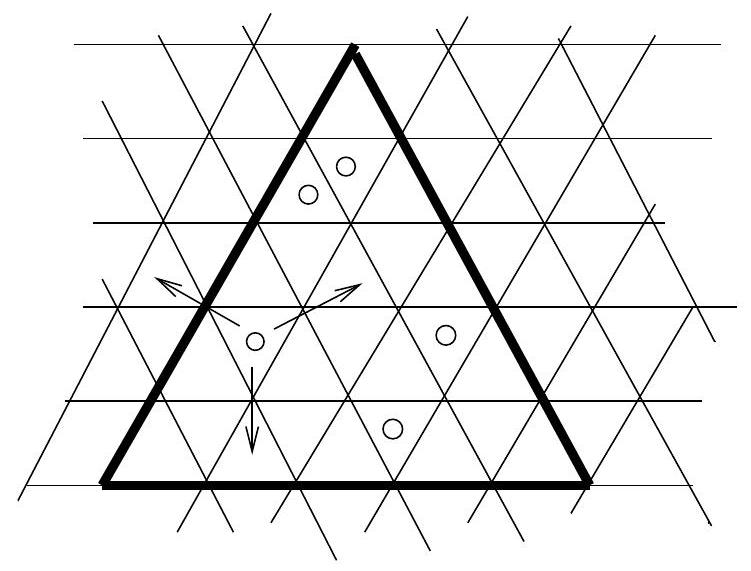
Figure 1
A polygon with vertices is given. Show that it is possible to label the vertices and midpoints of the sides of the polygon, using all the numbers , so that the sums of the three numbers assigned to each side are all equal.
In the triangle , let be the bisector of the external angle at . The line through the midpoint of the segment parallel to meets the line at . Determine , if and .
Prove that there exists a number such that for any triangle the inequality
holds, where denote the lengths of the altitudes and denote the lengths of the medians. Find the smallest possible value of .
Let be the midpoint of the side of a triangle and let be the foot point of the altitude from . Let and be the orthogonal projections of and on the bisector of angle . Prove that the four points and lie on the same circle.
The following construction is used for training astronauts: A circle of radius rolls along the inside of another, fixed circle of radius , where is an integer greater than 2 . The astronaut is fastened to a third circle of radius which rolls along the inside of circle in such a way that the touching point of the circles and remains at maximum distance from the touching point of the circles and at all times (see Figure 3).
How many revolutions (relative to the ground) does the astronaut perform together with the circle while the circle completes one full lap around the inside of circle ?
Prove that if both coordinates of every vertex of a convex pentagon are integers, then the area of this pentagon is not less than .