Let be positive real numbers. Prove that
Balkan MO Shortlist 2016.
Let be positive real numbers. Prove that
For all satisfying , prove that
Find all monotonic functions satisfying the condition: for every real number and every natural number
where is independent of and .
The positive real numbers satisfy the equality . For every natural number find the minimal possible value of the expression
Let and be real numbers such that and . Find the minimum value and the maximum value of the product .
Prove that there is no function from positive real numbers to itself, such that:
Find all integers for which there exist the real numbers , which are satisfying the following conditions:
Find all functions for which is independent on for any .
Let positive integers and be given. Prove that there exists a positive integer and a sequence of positive integers such that the number is a -digit palindrome in all number bases .
There are 2016 costumers who entered a shop on a particular day. Every customer entered the shop exactly once. (i.e. the customer entered the shop, stayed there for some time and then left the shop without returning back.) Find the maximal such that the following holds: There are customers such that either all of them were in the shop at a specific time instance or no two of them were both in the shop at any time instance.
The plane is divided into unit squares by means of two sets of parallel lines. The unit squares are coloured in 1201 colours so that no rectangle of perimeter 100 contains two squares of the same colour. Show that no rectangle of size contains two squares of the same colour.
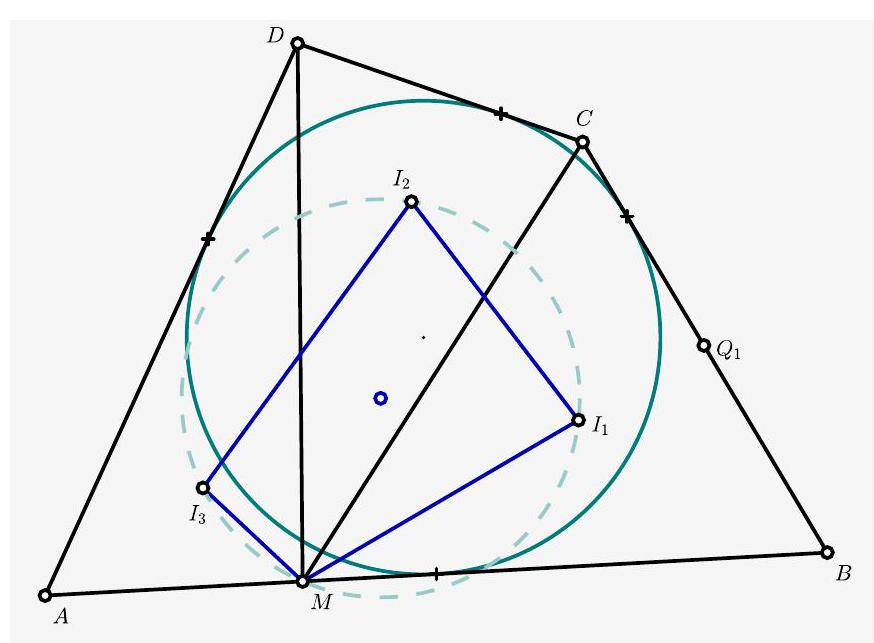
The point lies on the side of the circumscribed quadrilateral . The points , and are the incenters of , and . Show that the points , and lie on a circle.
Let be a cyclic quadrilateral, with , whose diagonals intersect at the point and intersect at the point . Let also be the projections of onto the sides respectively, and be the midpoints of . Prove that the second intersection point of the circumcircles of the triangles lies on the side .
Given that is a triangle where . On the half-lines and we take points and respectively such that . Let and be the mid-points of the segments and respectively and and be the circumcircles of the triangles and respectively. We assume that cuts and at the points and respectively and that is the point of intersection of and . If the parallel line from to cuts the line at and the perpendicular from to the line cuts at the point , prove that is the orthocenter of the triangle .
Find all natural numbers for which is coprime with .
Find all odd natural numbers such that is the largest divisor of the number different from is the number of divisors of the number including 1 and ).
Find all the integer solutions of the equation
Find all monic polynomials with integer coefficients satisfying the following condition: There exists a positive integer such that for every prime divides .
A positive integer is downhill if its decimal representation satisfies . A real-coefficient polynomial is integer-valued if is an integer for all integer , and downhill-integervalued if is an integer for all downhill positive integers . Is it true that every downhill-integer-valued polynomial is also integer-valued?