- Paper
- Answer
Compute the sum for .
Asian Pacific Mathematics Olympiad 2000.
Compute the sum for .
Given the following arrangement of circles:
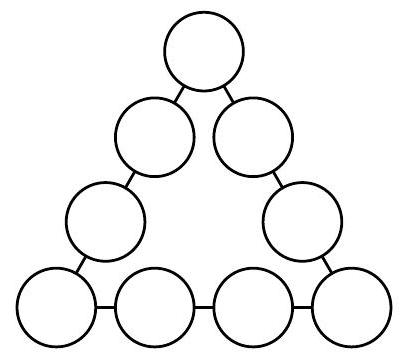
Each of the numbers is to be written into one of these circles, so that each circle contains exactly one of these numbers and (i) the sums of the four numbers on each side of the triangle are equal; (ii) the sums of squares of the four numbers on each side of the triangle are equal.
Find all ways in which this can be done.
Let be a triangle. Let and be the points in which the median and angle bisector, respectively, at meet the side . Let and be the points in which the perpendicular at to meets and , respectively, and be the point in which the perpendicular at to meets produced. Prove that is perpendicular to .
Let be given positive integers with . Prove that
Given a permutation of the sequence . A transposition of with is called legal if for , and . The permutation is called regular if after a number of legal transpositions it becomes . For which numbers is the permutation regular?