Let be a finite collection of squares in the coordinate plane such that the vertices of all squares that belong to are , and for some integers and . Show that there exists a subcollection of such that contains at least of the squares in , but no two of the squares in have a common vertex.
NMC 2001
Nordic Mathematical Contest 2001.
Other problems
Let be a bounded real function defined for all real numbers and satisfying for all real numbers the condition
Show that is periodic. (A function is bounded, if there exists a number such that for all real numbers . A function is periodic, if there exists a positive number such that for all real numbers .)
Determine the number of real roots of the equation
Let be a convex hexagon, in which each of the diagonals , and divides the hexagon in two quadrilaterals of equal area. Show that , and are concurrent.
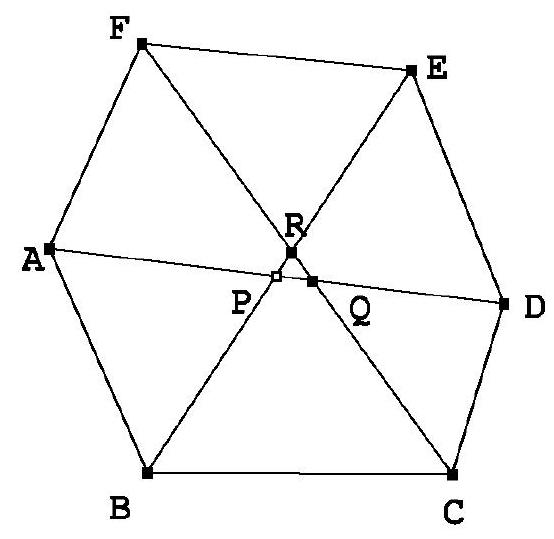
Figure 12.