Let be positive real numbers such that abc . Show that
so
JBMO Shortlist 2012.
Let be positive real numbers such that abc . Show that
so
Let c ce positue real numbers such that . Shou that
Solve the following equation for
Find the largest positive integer for which the inequality
holds for all . Here .
Along a round table are arranged 11 cards with the names (all distinct) of the 11 members of the JBMO Problem Selection Committee. The distances between each two consecutive cards are equal. Assume that in the first meeting of the Committee none of its 11 members sits in front of the card with his name. Is it possible to rotate the table by some angle so that at the end at least two members of sit in front of the card with their names?
nails nailed on a board are connected by two via a string. Each string is colored in one of given colors. For any three colors there exist three nails conne.cted by two with strings in these three colors. Can be: (a) 6, (b) 7?
In a circle of diameter 1 consider 65 points no three of which are collinear. Prove that there exist 3 among these points which form a triangle with area less then or equal to .
Let be an equilateral triangle, and a point on the circumcircle of the triangle and distinct from and . If the lines through and parallel to intersect the lines at and respectively, prove that and are collinear.
Let be an acute-angled triangle with circumcircle , and let be the triangle's circumcenter and orthocenter respectively. Let also be the point where the angle bisector of angle meets . If , find the measure of angle .
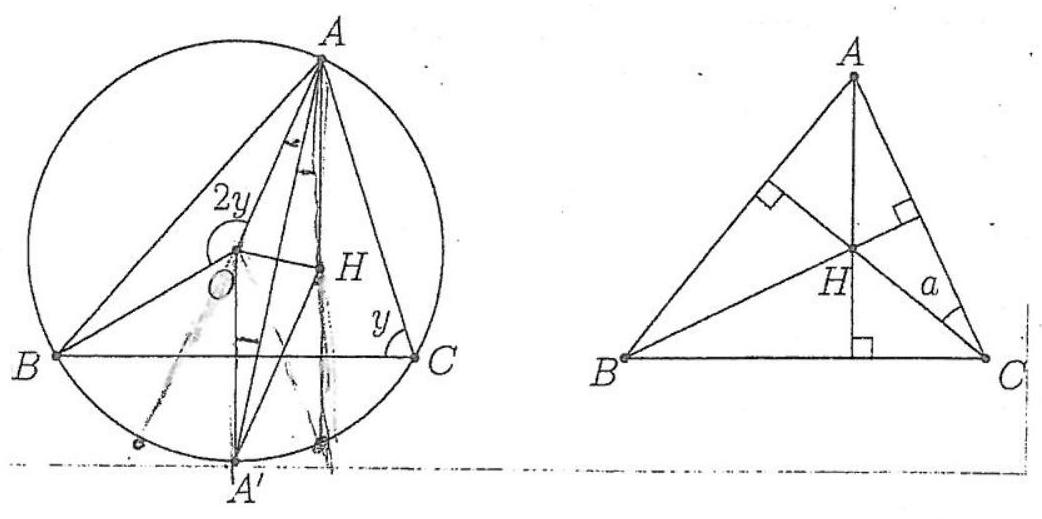
Figure 4: Exercise G4.