The real numbers satisfy simultaneously the equations
Prove that .
JBMO Shortlist 2010.
The real numbers satisfy simultaneously the equations
Prove that .
Determine all four digit numbers such that
Find all pairs of real numbers such that and .
Let be positive real numbers such that . Prove the inequality
and determine all cases when equality holds.
The real positive numbers satisfy the relations , . Prove that .
There are two piles of coins, each containing 2010 pieces. Two players A and B play a game taking turns (A plays first). At each turn, the player on play has to take one or more coins from one pile or exactly one coin from each pile. Whoever takes the last coin is the winner. Which player will win if they both play in the best possible way?
A rectangle is tiled with pieces of two types, shown in the picture below.
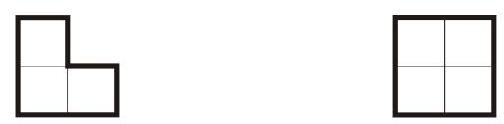
Find the possible values of the number of the pieces which can be used in such a tiling.
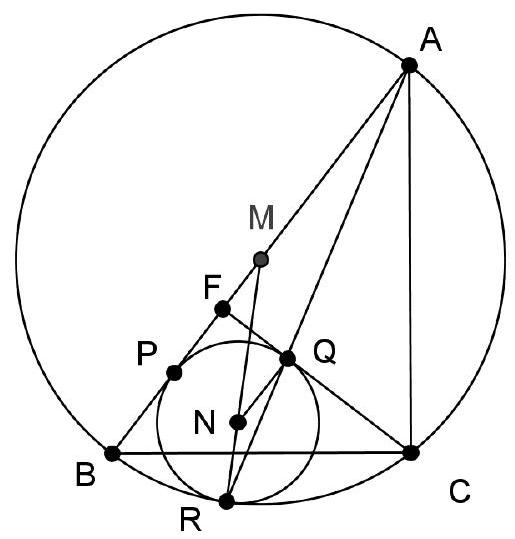
Consider a triangle with . Let be the foot of the altitude from . Circle touches the line segment at point , the altitude at point and the circumcircle of at point . Prove that points are collinear and .
Consider a triangle and let be the midpoint of the side . Suppose and . Find the measure of .
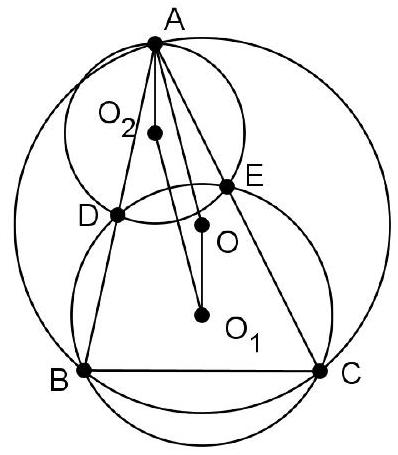
Let be an acute-angled triangle. A circle passes through points and and meets the sides and at points and , respectively. Let be the circumcircle of the triangle . Prove that is equal to the circumradius of the triangle .
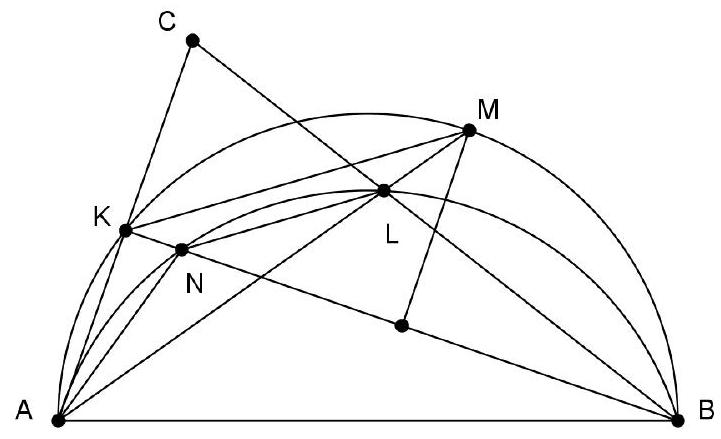
Let and be angle bisectors in the non-isosceles triangle . The perpendicular bisector of intersects the line at point . Point lies on the line such that . Prove that .
Find all positive integers such that is a perfect square.
Find all positive integers such that is a product of two or more consecutive positive integers.