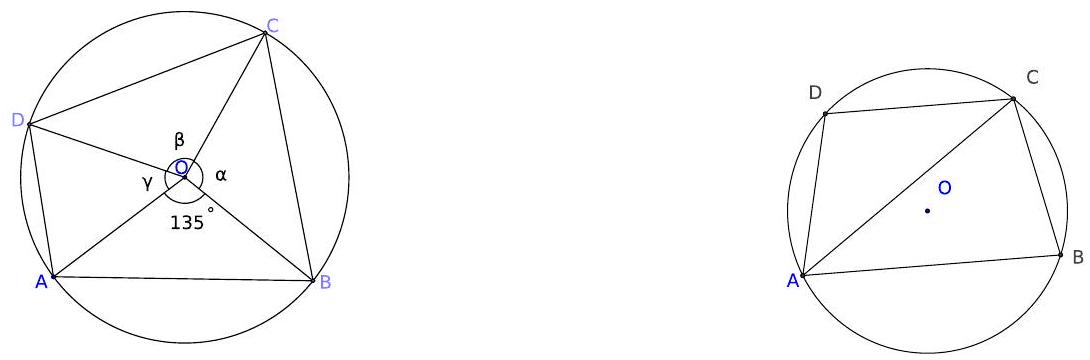
Let be a quadrilateral inscribed in a circle. Suppose and subtends at the centre of the circle. Find the maximum possible area of .
INMO 2012
Indian National Mathematical Olympiad 2012.
Other problems
Let and be two sets of prime numbers such that and . Suppose and . Prove that 30 divides .
Define a sequence of functions by
Prove that each is a polynomial with integer coefficients.
Let be a triangle. An interior point of is said to be good if we can find exactly 27 rays emanating from intersecting the sides of the triangle such that the triangle is divided by these rays into 27 smaller triangles of equal area. Determine the number of good points for a given triangle .
Let be an acute-angled triangle, and let be points on , respectively such that is the median, is the internal angle bisector and is the altitude. Suppose and . Prove that is equilateral.
Let be a function satisfying and
(i) ;
(ii) ,
for all , simultaneously.
(a) Find the set of all possible values of the function .
(b) If and , find the set of all integers such that .