olymmath

EGMO 2012

European Girls' Mathematical Olympiad 2012.

Day 1

Problem 1

  • Day 1

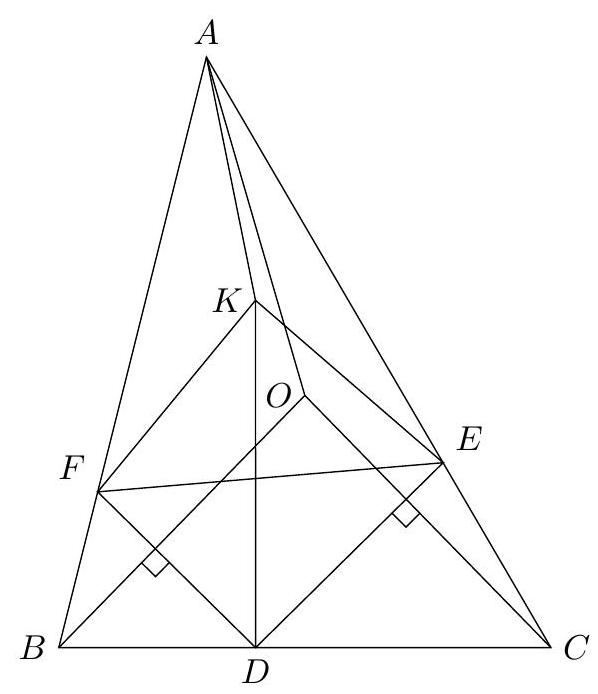
Let ABCA B C be a triangle with circumcentre OO. The points D,ED, E and FF lie in the interiors of the sides BC,CAB C, C A and ABA B respectively, such that DED E is perpendicular to COC O and DFD F is perpendicular to BOB O. (By interior we mean, for example, that the point DD lies on the line BCB C and DD is between BB and CC on that line.)

Let KK be the circumcentre of triangle AFEA F E. Prove that the lines DKD K and BCB C are perpendicular. Origin. Netherlands (Merlijn Staps).
Answer, solutions and source

Problem 2

  • Day 1
  • Answer

Let nn be a positive integer. Find the greatest possible integer mm, in terms of nn, with the following property: a table with mm rows and nn columns can be filled with real numbers in such a manner that for any two different rows [a1,a2,…,an]\left[a_{1}, a_{2}, \ldots, a_{n}\right] and [b1,b2,…,bn]\left[b_{1}, b_{2}, \ldots, b_{n}\right] the following holds:

max⁡(∣a1−b1∣,∣a2−b2∣,…,∣an−bn∣)=1\max \left(\left|a_{1}-b_{1}\right|,\left|a_{2}-b_{2}\right|, \ldots,\left|a_{n}-b_{n}\right|\right)=1

Origin. Poland (Tomasz Kobos).

Answer, solutions and source

Problem 3

  • Day 1
  • Answer

Find all functions f:R→Rf: \mathbb{R} \rightarrow \mathbb{R} such that

f(yf(x+y)+f(x))=4x+2yf(x+y)f(y f(x+y)+f(x))=4 x+2 y f(x+y)

for all x,y∈Rx, y \in \mathbb{R}.

Origin. Netherlands (Birgit van Dalen).

Answer, solutions and source

Day 2

Problem 4

  • Day 2

A set AA of integers is called sum-full if A⊆A+AA \subseteq A+A, i.e. each element a∈Aa \in A is the sum of some pair of (not necessarily different) elements b,c∈Ab, c \in A. A set AA of integers is said to be zero-sum-free if 0 is the only integer that cannot be expressed as the sum of the elements of a finite nonempty subset of AA.

Does there exist a sum-full zero-sum-free set of integers?

Origin. Romania (Dan Schwarz). Remark. The original formulation of this problem had a weaker definition of zero-sum-free that did not require all nonzero integers to be sums of finite nonempty subsets of AA.

Answer, solutions and source

Problem 5

  • Day 2

The numbers pp and qq are prime and satisfy

pp+1+q+1q=2nn+2\frac{p}{p+1}+\frac{q+1}{q}=\frac{2 n}{n+2}

for some positive integer nn. Find all possible values of q−pq-p. Origin. Luxembourg (Pierre Haas).

Answer, solutions and source

Problem 6

  • Day 2

There are infinitely many people registered on the social network Mugbook. Some pairs of (different) users are registered as friends, but each person has only finitely many friends. Every user has at least one friend. (Friendship is symmetric; that is, if AA is a friend of BB, then BB is a friend of AA.)

Each person is required to designate one of their friends as their best friend. If AA designates BB as her best friend, then (unfortunately) it does not follow that BB necessarily designates AA as her best friend. Someone designated as a best friend is called a 1-best friend. More generally, if n>1n>1 is a positive integer, then a user is an nn-best friend provided that they have been designated the best friend of someone who is an (n−1)(n-1)-best friend. Someone who is a kk-best friend for every positive integer kk is called popular. (a) Prove that every popular person is the best friend of a popular person. (b) Show that if people can have infinitely many friends, then it is possible that a popular person is not the best friend of a popular person.

Origin. Romania (Dan Schwarz) (rephrasing by Geoff Smith). Remark. The original formulation of this problem was: Given a function f:X→Xf: X \rightarrow X, let us use the notations f0(X):=X,fn+1(X):=f(fn(X))f^{0}(X):=X, f^{n+1}(X):=f\left(f^{n}(X)\right) for n≥0n \geq 0, and also fω(X):=⋂n≥0fn(X)f^{\omega}(X):=\bigcap_{n \geq 0} f^{n}(X). Let us now impose on ff that all its fibres f−1(y):={x∈X∣f(x)=y}f^{-1}(y):=\{x \in X \mid f(x)=y\}, for y∈f(X)y \in f(X), are finite. Prove that f(fω(X))=fω(X)f\left(f^{\omega}(X)\right)=f^{\omega}(X).

Answer, solutions and source