olymmath

CMO 2010

Canadian Mathematical Olympiad 2010.

Paper

Problem 1

  • Paper

For a positive integer nn, an nn-staircase is a figure consisting of unit squares, with one square in the first row, two squares in the second row, and so on, up to nn squares in the nth n^{\text {th }} row, such that all the left-most squares in each row are aligned vertically. For example, the 5 -staircase is shown below.
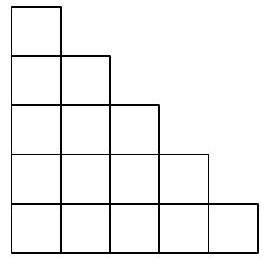
Let f(n)f(n) denote the minimum number of square tiles required to tile the nn staircase, where the side lengths of the square tiles can be any positive integer. For example, f(2)=3f(2)=3 and f(4)=7f(4)=7.

(a) Find all nn such that f(n)=nf(n)=n.

(b) Find all nn such that f(n)=n+1f(n)=n+1.

Answer, solutions and source

Problem 2

  • Paper
  • Answer

Let A,B,PA, B, P be three points on a circle. Prove that if aa and bb are the distances from PP to the tangents at AA and BB and cc is the distance from PP to the chord ABA B, then c2=abc^{2}=a b.

Answer, solutions and source

Problem 3

  • Paper
  • Answer

Three speed skaters have a friendly race on a skating oval. They all start from the same point and skate in the same direction, but with different speeds that they maintain throughout the race. The slowest skater does 1 lap a minute, the fastest one does 3.14 laps a minute, and the middle one does LL laps a minute for some 1<L<3.141<L<3.14. The race ends at the moment when all three skaters again come together to the same point on the oval (which may differ from the starting

Answer, solutions and source

Problem 4

  • Paper

Each vertex of a finite graph can be colored either black or white. Initially all vertices are black. We are allowed to pick a vertex P\mathrm{P} and change the color of PP and all of its neighbours. Is it possible to change the colour of every vertex from black to white by a sequence of operations of this type?

Answer, solutions and source

Problem 5

  • Paper

Let P(x)P(x) and Q(x)Q(x) be polynomials with integer coefficients. Let an=n!+na_{n}=n !+n. Show that if P(an)/Q(an)P\left(a_{n}\right) / Q\left(a_{n}\right) is an integer for every nn, then P(n)/Q(n)P(n) / Q(n) is an integer for every integer nn such that Q(n)≠0Q(n) \neq 0.

Answer, solutions and source