olymmath

CMO 2006

Canadian Mathematical Olympiad 2006.

Paper

Problem 1

  • Paper
  • Answer

Let f(n,k)f(n, k) be the number of ways of distributing kk candies to nn children so that each child receives at most 2 candies. For example, if n=3n=3, then f(3,7)=0,f(3,6)=1f(3,7)=0, f(3,6)=1 and f(3,4)=6f(3,4)=6.

Determine the value of

f(2006,1)+f(2006,4)+f(2006,7)+⋯+f(2006,1000)+f(2006,1003).f(2006,1)+f(2006,4)+f(2006,7)+\cdots+f(2006,1000)+f(2006,1003) .

Comment. Unfortunately, there was an error in the statement of this problem. It was intended that the sum should continue to f(2006,4012)f(2006,4012).

Answer, solutions and source

Problem 2

  • Paper

Let ABCA B C be an acute-angled triangle. Inscribe a rectangle DEFGD E F G in this triangle so that DD is on AB,EA B, E is on ACA C and both FF and GG are on BCB C. Describe the locus of (i.e., the curve occupied by) the intersections of the diagonals of all possible rectangles DEFGD E F G.

Answer, solutions and source

Problem 3

  • Paper
  • Answer

In a rectangular array of nonnegative real numbers with mm rows and nn columns, each row and each column contains at least one positive element. Moreover, if a row and a column intersect in a positive element, then the sums of their elements are the same. Prove that m=nm=n.

Answer, solutions and source

Problem 4

  • Paper
  • Answer

Consider a round-robin tournament with 2n+12 n+1 teams, where each team plays each other team exactly once. We say that three teams X,YX, Y and ZZ, form a cycle triplet if XX beats Y,YY, Y beats ZZ, and ZZ beats XX. There are no ties.

(a) Determine the minimum number of cycle triplets possible.

(b) Determine the maximum number of cycle triplets possible.

Answer, solutions and source

Problem 5

  • Paper

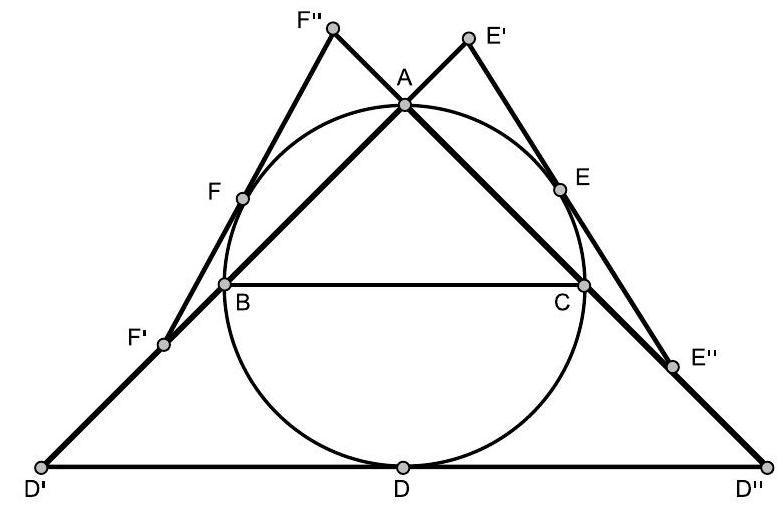
The vertices of a right triangle ABCA B C inscribed in a circle divide the circumference into three arcs. The right angle is at AA, so that the opposite arc⁡BC\operatorname{arc} B C is a semicircle while arc⁡AB\operatorname{arc} A B and arc⁡AC\operatorname{arc} A C are supplementary. To each of the three arcs, we draw a tangent such that its point of tangency is the midpoint of that portion of the tangent intercepted by the extended lines ABA B and ACA C. More precisely, the point DD on arc⁡BC\operatorname{arc} B C is the midpoint of the segment joining the points D′D^{\prime} and D′′D^{\prime \prime} where the tangent at DD intersects the extended lines ABA B and ACA C. Similarly for EE on arc ACA C and FF on arc ABA B.

Prove that triangle DEFD E F is equilateral.

Answer, solutions and source