olymmath

CMO 2002

Canadian Mathematical Olympiad 2002.

Paper

Problem 1

  • Paper
  • Answer

Let SS be a subset of {1,2,…,9}\{1,2, \ldots, 9\}, such that the sums formed by adding each unordered pair of distinct numbers from SS are all different. For example, the subset {1,2,3,5}\{1,2,3,5\} has this property, but {1,2,3,4,5}\{1,2,3,4,5\} does not, since the pairs {1,4}\{1,4\} and {2,3}\{2,3\} have the same sum, namely 5 .

What is the maximum number of elements that SS can contain?

Answer, solutions and source

Problem 2

  • Paper

Call a positive integer nn practical if every positive integer less than or equal to nn can be written as the sum of distinct divisors of nn.

For example, the divisors of 6 are 1,2,3\mathbf{1 , 2}, \mathbf{3}, and 6\mathbf{6}. Since

1=1,2=2,3=3,4=1+3,5=2+3,6=6,1=\mathbf{1}, 2=\mathbf{2}, 3=\mathbf{3}, 4=\mathbf{1}+\mathbf{3}, 5=\mathbf{2}+\mathbf{3}, 6=\mathbf{6},

we see that 6 is practical.

Prove that the product of two practical numbers is also practical.

Answer, solutions and source

Problem 3

  • Paper

Prove that for all positive real numbers a,ba, b, and cc,

a3bc+b3ca+c3ab≥a+b+c\frac{a^{3}}{b c}+\frac{b^{3}}{c a}+\frac{c^{3}}{a b} \geq a+b+c

and determine when equality occurs.

Each of the inequalities used in the solutions below has the property that equality holds if and only if a=b=ca=b=c. Thus equality holds for the given inequality if and only if a=b=ca=b=c.

Answer, solutions and source

Problem 4

  • Paper
  • Answer

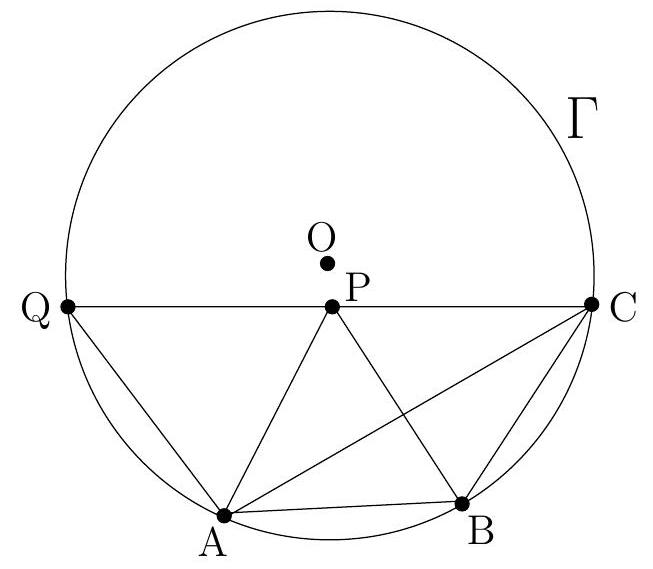
Let Γ\Gamma be a circle with radius rr. Let AA and BB be distinct points on Γ\Gamma such that AB<3rA B<\sqrt{3} r. Let the circle with centre BB and radius ABA B meet Γ\Gamma again at CC. Let PP be the point inside Γ\Gamma such that triangle ABPA B P is equilateral. Finally, let CPC P meet Γ\Gamma again at QQ. Prove that PQ=rP Q=r.

Answer, solutions and source

Problem 5

  • Paper
  • Answer

Let N={0,1,2,…}\mathbb{N}=\{0,1,2, \ldots\}. Determine all functions f:N→Nf: \mathbb{N} \rightarrow \mathbb{N} such that

xf(y)+yf(x)=(x+y)f(x2+y2)x f(y)+y f(x)=(x+y) f\left(x^{2}+y^{2}\right)

for all xx and yy in N\mathbb{N}.

Answer, solutions and source